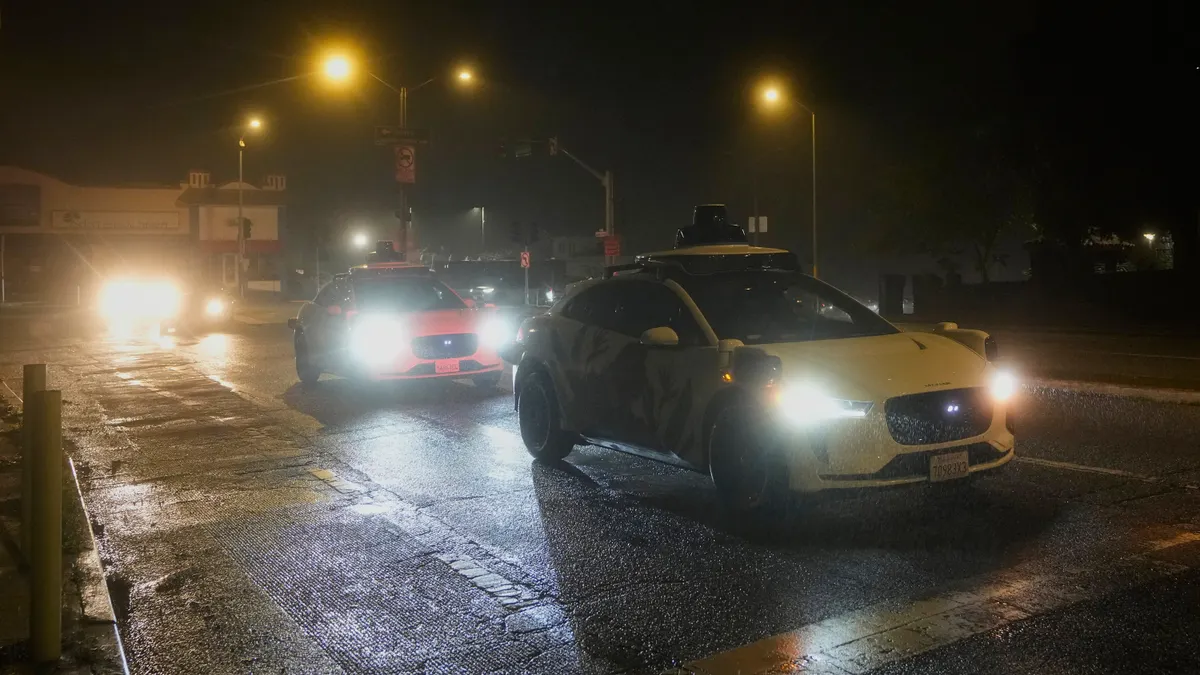

UPDATE: Jan. 5, 2026: Waymo said it is rolling out fleet-wide updates to give its vehicles more context on region-wide power outages following its robotaxis’ response to a Dec. 20 blackout in San Francisco that caused traffic chaos.
“An event of this magnitude presented a unique challenge for autonomous technology,” the company said in a Dec. 23, 2025, statement. While its vehicles are programmed to treat dark traffic signals as four-way stops, they can “request a confirmation check to ensure it makes the safest choice.” That overwhelmed Waymo's ability to respond to these requests, the company said.
As the blackout continued, “We directed our fleet to pull over and park appropriately so we could return vehicles to our depots in waves,” Waymo said.
The fleetwide update will allow the robotaxis “to navigate these intersections more decisively.”
Waymo added that it will improve its emergency response protocols, “incorporating lessons from this event,” and update its first responder training.
Dive Brief:
- Waymo robotaxis ground to a halt Saturday in San Francisco when a power outage affected traffic signals, according to social media and news reports.
- The stopped vehicles backed up traffic, leading Waymo to suspend service across the city.
- Waymo restored service Sunday after most of the city’s electric service came back online, but experts say the failure was foreseeable and robotaxi regulators should plan ahead for such emergencies.
Dive Insight:
Pacific Gas and Electric, the utility that serves San Francisco, said it “began to experience a significant outage” at 1:09 pm Saturday that peaked two hours later, affecting about 130,000 customers. PG&E attributed the outage to a fire at one of its substations, where damage “was significant and extensive,” the company said on its website.
“Throughout the outage, we closely coordinated with San Francisco city officials,” a Waymo spokesperson said in an email. “The sheer scale of the outage led to instances where vehicles remained stationary longer than usual to confirm the state of the affected intersections.”
Experts said Waymo should have been ready for such an event.
“The failure of robotaxis in San Francisco during the power outage yesterday was entirely foreseeable,” Philip Koopman, a Carnegie Mellon University professor emeritus and safety expert in autonomous vehicles, said in a LinkedIn post.
“Robotaxi companies and regulators need to be planning now for emergencies!” Matthew Wansley, a professor at the Cardozo School of Law, said on LinkedIn. He referred to an Oct. 14, 2025, paper, which he coauthored.
“Emergency management officials and robotaxi regulators shouldn’t wait until an emergency arises to verify if robotaxi companies can meet their obligations,” stated the authors of the paper on regulating robotaxis to be published in a forthcoming issue of the Southern California Law Review. “They should require robotaxi companies—as well as providers of automated driving for personal motor vehicles—to participate in simulations in which they test how companies would respond to different types of emergencies.”
Waymo said in an email that most of the trips active at the time of the blackout were completed successfully before the vehicles were pulled over or returned to depots. “We are already learning and improving from this event,” the spokesperson said.
Elon Musk said in a post on X that “Tesla Robotaxis were unaffected by the SF power outage.” Tesla operates in San Francisco with human drivers on board. Zoox also operates a limited, invitation-only autonomous service in the city. It’s unclear whether its vehicles were affected by the blackout.
The power outage also disrupted service at certain San Francisco Municipal Transportation Agency subway stations. Bay Area Rapid Transit service through the Transbay Tube was halted for a time and closed service at some stations.