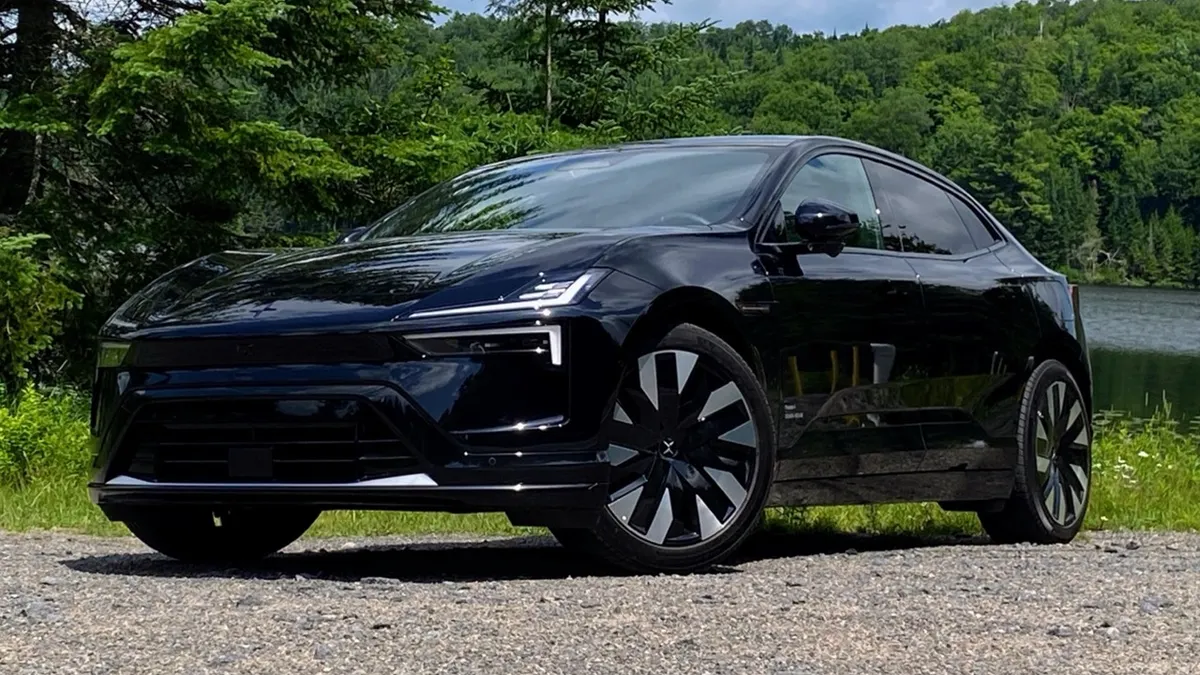
Not even the flashes of lightning and exceptionally dark afternoon sky prepared me for a torrential downpour, a delineated wall of water ahead prompted me to slow the 2026 Polestar 4 EV way down.
As I worked to focus ahead between fast sweeps of the windshield wipers, I glanced at the rearview display and marveled how I seemed to have a better, sharper field of vision behind the vehicle than in front.
It was probably not the venue that Polestar had hoped to provide for an early drive of the U.S.-spec Polestar 4—the first mass-market vehicle to completely nix the rear window. But it served to illustrate a point about this EV’s very unusual design: that the tech around its most controversial point works remarkably well.
Navigating out of Montreal through dense traffic on the way to twisty roads, I was concerned that my reading-glasses-dependent eyes would face an unusual kind of overload with the head-up display, the rearview camera display and the road ahead each being at different fields of focus. Yet, about an hour out, it simply wasn’t the case and I started appreciating that additional clarity.
Quick, agile and very quiet
Once accustomed to the driver layout before the storm hit, I found the Polestar 4 performed mostly as billed — a sporty and agile crossover that’s quieter and more comfortable than other so-called “SUV coupes.”
My first taste of the Polestar 4 was limited to the dual-motor model, delivering all-wheel drive and a combined 544 hp and 506 lb-ft of torque. In dual-motor form, the Polestar 4 is very quick with a 0-60 mph time of just 3.7 seconds. However, the single-motor version powering the rear wheels makes do with half the max output, with a 6.9-second 0-60 mph time.
The dual-motor variant includes multi-mode ZF active dampers with coil springs at all four wheels, in place of the single-motor version’s passive dampers. The $4,500 Performance pack, which my test car didn’t have, sharpens it up a bit with Brembo brakes, 22-inch wheels, stiffer springs and anti-roll bars.
Polestar’s suspension settings allow a lot of flexibility in how the car responds to inputs and I quickly found favorites. On the choppy backroads towards the Mont-Tremblant ski area, I found the Firm ride setting buttoned down bouncy body motions without added harshness. On the other hand, I preferred the less-artificial-feeling Light setting for steering feel.
The 2026 Polestar 4 has a 100-kWh battery pack (94 kWh usable), using a cell-to-pack format. It charges at up to 11 kW on a 240-volt home charger, which is good for a full charge in about 11 hours. For faster charging on road trips, it’s due to arrive with a Tesla-style NACS port (adapter optional) that supports DC fast-charging currents that peak near 200 kW, providing a 10-80% battery charge in as little as 30 minutes, according to Polestar.
On a test drive with a mix of twisty back roads and congested freeways, we covered a total of 188 miles. According to the EV’s trip meter, average efficiency was nearly 3.7 miles per kWh, suggesting a real-world range approaching 350 miles. The Polestar 4 earns an official EPA ratings of up to 310 miles for the single-motor version and 280 miles for the dual-motor.
Efficient and responsive despite a tangle of modes
The Polestar 4 offers two power delivery modes, Range and Performance, as well as three levels of regenerative braking: Standard, Low and Off. Upon startup, the EV defaults to Range mode, which adds a rubber-band-like latency to the accelerator pedal, belying the EV’s sporty intent (think old-style turbo lag). It’s an especially odd complement when paired with the Standard regenerative braking setting, which comes on instantly when taking your foot off of the accelerator pedal to sharply slow the EV to a halt without having to press the brake pedal.
As the counterpoint to that Range setting, the Performance setting ramps up accelerator sensitivity to match, arriving at something edgier than what commuters might expect. But what I found missing was a just-right Normal mode between those, to best pair with this EV's Low regenerative braking setting.
In dual-motor Polestar 4 models, the front motor can disconnect to boost efficiency by running the EV in rear-wheel-drive mode, and I found it imperceptible. However, when put into Range mode, efficiency behavior was less harmonious.
Among other electric crossovers with swoopy rooflines and sporting pretenses, Polestar sees the 4 rivaling the Porsche Macan Electric. The Polestar 4 launch edition starts at $57,800 and includes the Pilot pack, bringing a partial hands-free mode to the adaptive cruise control at up to 81 mph, as well as automatic lane changes with a flick of the turn signal stalk.
In all markets, the Polestar 4 comes with Mobileye’s SuperVision advanced driver assist technology, which incorporates a lidar system from Luminar and a mid-range front-facing imaging radar. The EV also has a total of 11 exterior cameras and 12 ultrasonic sensors. I had to turn off an inward safety feature, the Driver Alert system, because of its frequent ping of false alarms (I’m 6 ft. 6 in.).
Past $80k fully loaded
The early build U.S.-spec Polestar 4 I drove costs $78,100 and included the $5,500 Plus pack that adds a Harman Kardon premium sound system, head-up display, three-zone climate control, a rear control screen for climate and entertainment, power tailgate and more. It also was equipped with 21-inch alloy wheels, a $1,500 electrochromic roof and $3,700 Bridge of Weir leather upgrade. Polestar touts that it uses 100% traced leather that’s “animal welfare secured.” There’s also an “Animal Mode” that runs the climate control, showing passers-by the interior temperature and that the pet’s owner will be back soon.
Other options include a $1,895 tow package with a towing capacity of 3,500-pounds for a braked trailer or 1,650 lbs for an unbraked one. For those drivers who seek a steep, loose trail for off-roading, hill descent control is included, although the Polestar 4’s 6.5-inch ground clearance may limit its off-road capabilities.
The Polestar 4’s infotainment sytem include a 15.4-inch landscape-oriented center touchscreen built on Google’s Android Automotive OS, but it does support wireless Apple CarPlay. You’ll need to use the screen for side mirror, steering-wheel, and even vent adjustments. That said, the smaller gauge cluster screen and head-up display provides more options for drivers. There are also steering-wheel buttons for the adaptive cruise control, as well as a rotary volume/play/pause knob on the center console.
Spacious, tech-loaded, worldly is a lot to put in perspective
After spending a few hours in and around the 2026 Polestar 4, I was impressed by its innovative design. The EV also gets around one of the chief drawbacks of SUV coupe designs – the tight back seat. But Polestar’s engineers made a cargo compromise that can’t be corrected for with a camera system.
Thanks to the thin battery pack, drawn back roofline and pulled forward cowl, four or five adults will have enough legroom and headroom to sprawl out and get in and out without ducking. With the exception of the confounding decision to design confining, tightly boxed-out front seatwells, passenger spaciousness is the priority. Although there’s a modest frunk, the EV’s narrow rear liftgate opening really limits how much larger cargo you can fit (even with the seats folded).
In addition to all the packaging, tech and push-and-pull, the 2026 Polestar 4 EV has quite the passport. Instead of coming from China, as Polestar 4s have been for the rest of the world for the past year or two, North America–bound versions of the Swedish-engineered EV will be built in South Korea at a factory run by French automaker Renault.
How will shoppers put it all in perspective? As this loaded-with-quirks Polestar 4 arrives in the U.S., the brand might want to consider making long test-drives part of the process.