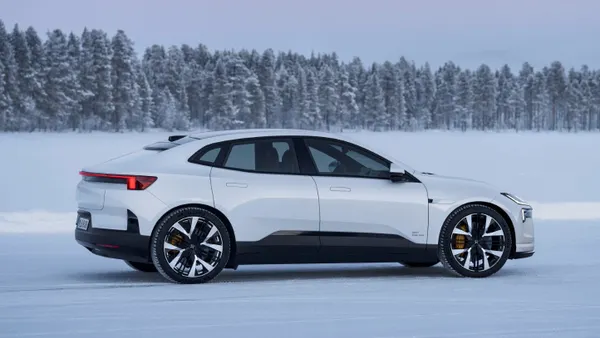


Mitsubishi unveils its first fullsize battery-electric vehicle in Europe as proof that the Renault-Nissan-Mitsubishi Alliance is alive and well, at least in some aspects.
Indeed, the Alliance issues a joint statement ahead of the wraps coming off the Mitsubishi Eclipse Cross compact SUV stressing the partners’ commitment and cooperation in BEV development.
At a meeting at Ampere’s site in Douai, France, Nissan CEO Ivan Espinosa, Mitsubishi boss Takao Kato and new chief of Renault François Provost agree on plans to deliver future BEVs tailored to European customers.
“It’s Mitsubishi’s first BEV in Europe since the pioneering i-MiEV, our first electric vehicle to enter full series production, making it an essential model with a key role to play as we continue our journey towards electrification in Europe,” Frank Krol, president and CEO of Mitsubishi Motors Europe, says in a news release.
The Mitsubishi Eclipse Cross joins Nissan’s Micra and the Renault 4 and 5 using Ampere’s AmpR platforms, albeit the Eclipse employs the larger Small AmpR Medium platform and becomes the first French-built Mitsubishi model expected to reach European markets next year. Series production is expected to begin at the Douai, France, plant in the final quarter of 2025.
This model’s headline news is a long-range version using an 87-kWh battery pack claiming a maximum range between charges of 372 miles (600 km).
It is built on the CMF-EV platform, with its dimensions – 176 ins. (4,470 mm) long, 73 ins. (1,860 mm) wide and 62 ins. (1,570 mm) tall – enriching its presence, Mitsubishi says.
At launch, the Eclipse Cross BEV will be offered in two power-pack options although the automaker has yet to release full details of the small battery pack. But it is expected to at least match that used by the Renault 5 at 52 kWh, allowing a range of about 250 miles (403 km).
A water-cooled thermal management system helps maintain battery performance and the Eclipse Cross is also equipped with a heat pump as well as a positive temperature coefficient heater to provide climate control heating without drawing energy from the powertrain battery.
The vehicle’s electric motor in the long-range version claims a power output of 214 hp (160 kW) and maximum torque of 221 lb.-ft. (300 Nm), enough to claim a 0-to-62 mph (100 km/h) sprint time of 8.4 seconds on the way to a top speed of 105 mph (169 km/h).
The Eclipse Cross enables both Mode 2 charging, using a domestic outlet, and Mode 3 AC charging up to 22 kW using a dedicated charger and Type 2 socket. It can also handle public DC fast-charging points at speeds up to 150 kW using the CCS port.
Signature design elements include LED lighting front and rear, integrated door handles and a fullsize panoramic glass roof.
Inside, there’s luggage space of 16.9 cu.-ft. (478 L) but with a maximum load space in the rear of up to 59 cu.-ft. (1,670 L) with the rear seats folded back.
The cabin houses a 12.3-in. (31-cm) infotainment display plus another same-sized driver display showing vehicle status data.
The new Mitsubishi BEV has a Google operating system, including features such as Google Maps, Google Play and Google Assistant, the latter using conversational language recognition to control navigation, media streaming, phone and vehicle functionalities.
Safety devices include a vulnerable-road-user warning system emitting an acoustic warning to pedestrians, cyclists and others at 56-75dB.
The Eclipse Cross will come backed by Mitsubishi’s extended eight-year or 100,000-mile (160,000-km) warranty.