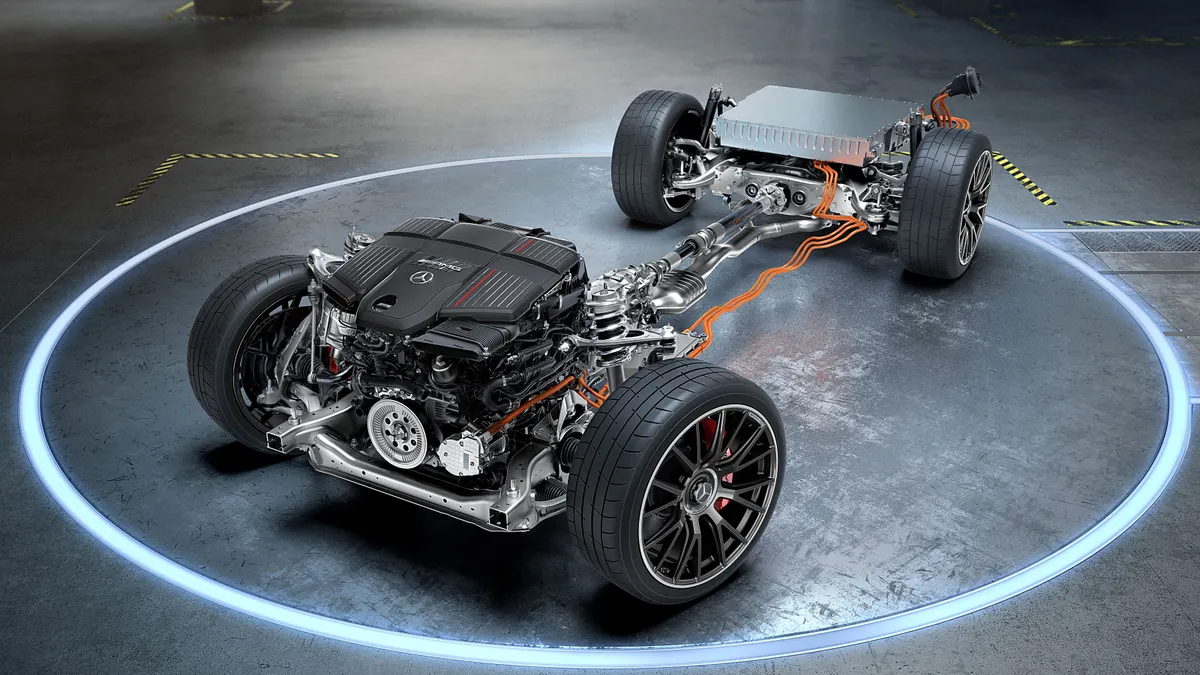
Plug-in hybrid-electrics are the most misunderstood propulsion systems in the world. Most consumers don’t comprehend them, and government regulators who do know how they work, say the only reason people buy PHEVs is to take advantage of EV income tax credits, which now are eliminated.
But no government incentive is needed to love the Mercedes-AMG E 53 plug-in hybrid powertrain, one of the 2025 Wards 10 Best Engines & Propulsion Systems’ winners. With a combined 604 hp and 553 lb.-ft (750 Nm) of torque, the powertrain makes the E 53 a luxurious, multi-talented thrill ride that accelerates from 0-60 mph (97 km/h) in 3.7 seconds and is almost as fast as the V-8-powered E 63.
The 3.0L I-6 makes glorious sounds during hard acceleration, but when the electric motor kicks in by itself with 354 lb.-ft. (480 Nm) of low-end torque, the car also can quickly transition into a serene space that is quiet as a library but still exhilarating.
Our 2025 test car’s 42-mile (68-km) electric range is significant, and Mercedes says the range goes up to 43 miles (69 km) for the 2026 model-year E 53. Typical commutes now are about 20 miles (32 km) each way and the E 53’s small 21-kWh battery can easily be fully recharged overnight with a standard home outlet. It also can go from 10% to 80% charge in about 20 minutes using a DC fast charger. That means drivers can spend less time at gas pumps or commercial charging stations than if they were driving a conventional ICE vehicle or a pure electric EV.
The car is EPA-rated at 59 MPGe combined when running on electricity and gasoline and 23 mpg (10.2 L/100 km) gasoline only. Wards 10 Best judges returned 31 mpg-62 mpg (7.6 L/100 km-3.8 L/100 km) in our test drives blending electric and gas power, impressive figures for a large luxury sedan.
Mercedes says the I-6 sees a 14-hp increase from its prior generation, with “numerous enhancements to software and hardware contributing to the engine's heightened performance and highly dynamic response.” One significant addition to the mill is a new twin-scroll exhaust-gas turbocharger with higher boost pressure of 21.8 psi versus 16 psi with the turbocharger in the previous I-6.
The motor, also making 161 hp, is integrated into the 9-speed automatic transmission. The automaker credits permanently excited internal rotor synchronous technology as helping achieve the high-power density of the hybrid unit.
The 28.6-kWh battery, located below the trunk floor, offers 21.2 kWh of energy for everyday driving, with the remainder reserved to give electric boost during high-performance maneuvers.
As in most PHEVs, battery power can be placed on hold, such as to maintain electricity for city driving, or be strictly relied on by selecting Electric mode.
D- mode allows for one-pedal driving with strong regeneration. Mercedes says the hybrid powertrain can recuperate up to 120 kW.
Despite some pricey extras on our $111,000 test car, the E 53’s innovative powertrain is what really sells the vehicle, with a combination of blistering performance, driving pleasure and convenience.
“This is a great piece of engineering by Mercedes. The E 53’s powertrain is powerful, efficient, responsive and silky smooth,” sums up 10 Best Judge Dave Zoia.
Plug-in Hybrid Powertrain Specifications
Engine: 3.0L Turbocharged I-6
Displacement: (cc) 2,999
Block/head material: aluminum/aluminum
Horsepower (SAE net): 443 hp @ 5,800-6,100 rpm
Torque: 413 lb.-ft. @ 2,200-5,000 rpm
Motor: 161 hp @ 2,000 rpm /354 lb.-ft (480 Nm) @ 0 rpm
Total system output: 577 hp (604 hp with Race Start)/553 lb.-ft. (750 Nm)
Specific output: 192 hp/L (201 hp/L w/ Race Start) (system net)
Electric only range: 42 miles (68 km)
EPA combined mpg/mpg-e: 23/59
Engine assembly site: Untertürkheim, Germany
Application tested: 2025 Mercedes-AMG E 53 Hybrid 4MATIC+
Source: Manufacturer data