Southern California has long been the beating heart of American car culture and the LA Auto Show has served up decades of product debuts and big business announcements, sometimes with star power from nearby Hollywood mixed in.
While the celebrity sizzle is gone from reveals, and auto shows are no longer the splashy news events they once were, the LA show remains a great place to compare vehicles up close and take in what’s new from a range of brands.
WardsAuto noted five trends and takeaways from this year’s show:
1) Established luxury brands skipped the show floor
Models like the BMW 3-Series and Lexus RX might seem like the core of the Southern California market but their brands, and the thriving near-luxury market, went mostly unrepresented at the show.
BMW, Mercedes and Audi added up to 9.5% of the California light vehicle market in 2024, according to the California New Car Dealers Association (CNCDA), and yet these German automakers missed their roll call with shoppers. Acura, Cadillac, Infiniti and Lexus were also missing from the main show halls, while dealership groups took the reins for Porsche.
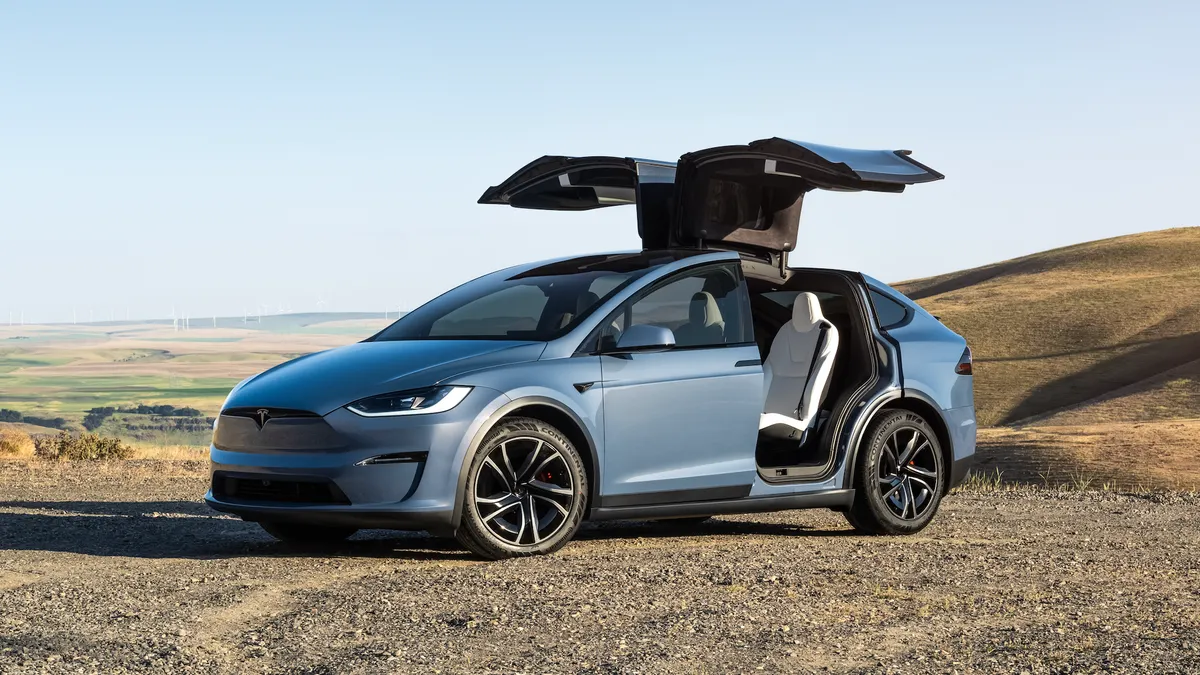
Also absent was Tesla. While the EV maker, which started in California, did exhibit at the LA show last year, the brand skipped the 2025 show.
2) SUV design is diversifying
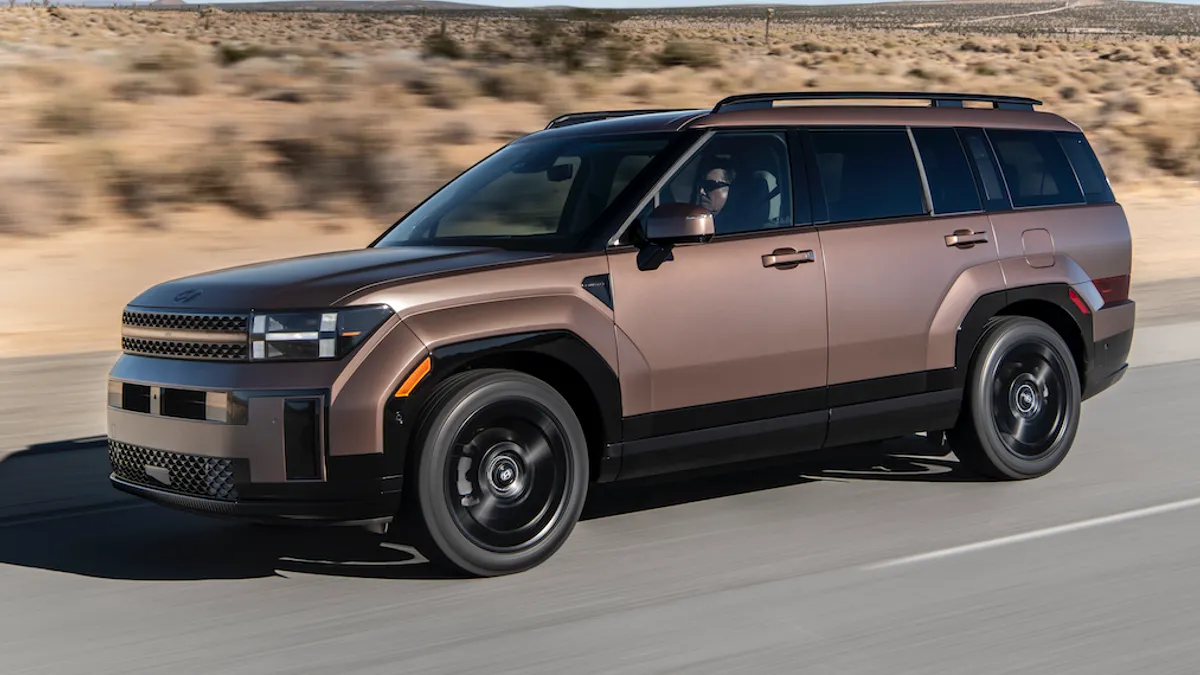
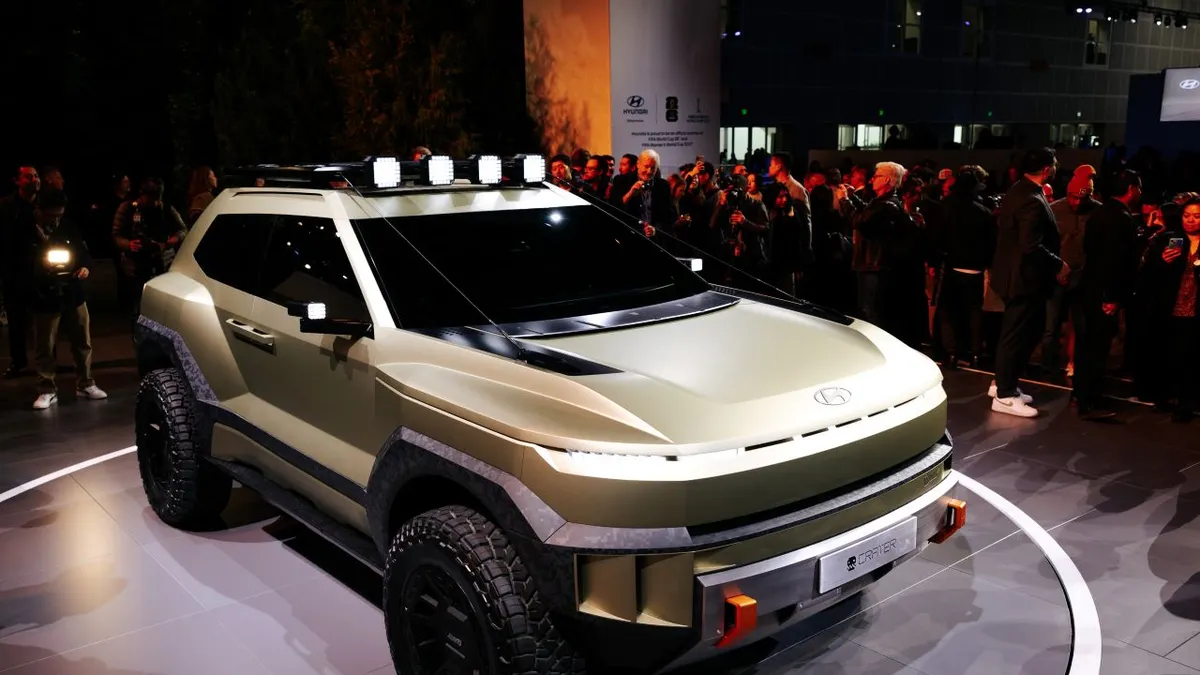
The LA show was the world premiere for the Hyundai Crater Concept, which rides on the same platform as the Ioniq 5 EV. With some of the cues extended from Hyundai’s trail-flavored XRT sub-brand, the Crater also flexed a new, confidently quirky Art of Steel design language that might fit into a garage alongside a Tesla Cybertruck (or, as I see it, an Isuzu Vehicross). It also presented a version of its Parametric Pixel details, including a skull logo throughout that looks part Minecraft, part Lego mini-figure. It also shed the giant screen space inside in favor of swappable modules.
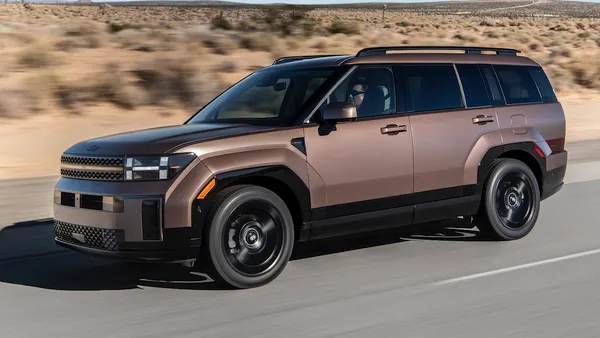
Meanwhile, the LA show also served as the official debut of a completely redesigned 2027 Kia Telluride. While it’s a few inches larger all round than the outgoing version, the clean, sharp, very upright design turns heads — including the huge, blacked-out grille in off-road-focused X-PRO trim, and trim and interface details that appear to borrow the best from the EV9.
While these two Korean brands were the boldest about the bifurcation, a quick look around the show suggested they aren’t anomalies; SUVs aren’t all blending in anymore and that’s a good thing.
3) Hybrids get a rebranding
With the 2027 Telluride introduced at LA, Kia drops the V-6 and instead opts for a hybrid system — combining electric motors with a 6-speed automatic transmission, a 1.65-kW lithium-ion battery and a 2.5-liter turbocharged in-line four. That combination makes an impressive 329 hp and 339 ft.-lb. of torque and is expected to return 35 mpg combined — a whopping 13 mpg better than before.
While Jeep, for instance, is quietly making all its Cherokees hybrids this time around, Kia is branding the Telluride hybrid the Turbo-Hybrid to emphasize improvement, according to Kia America marketing VP Russell Wager: “You get more mpg and you get more power.”
The production 2026 Honda Prelude also made its North American debut at the LA show, and it also marked the start of a sportier direction for Honda’s two-mode hybrid system. While electric motors power the front drive wheels most of the time, the 2.0-liter four acts as a generator, as with Honda’s other current Civic, Accord and CR-V hybrids. But in the Prelude, an added S+ Shift feature and S+ shift mode mimic the sounds and sensations you’d have with “real” shifts. It gets great mileage too, at an EPA-rated 44 mpg combined.
4) EVs embrace a lifestyle
EVs remain a big part of the California market, accounting for more than a fifth of the state’s new-vehicle sales, according to Experian data. And according to the CNCDA, EV sales surged to 24.7% in the third quarter of the year, leading up to the expiration of the EV tax credit.
EV sales are going to skew lower for some time but many of the products pushed hard on a fully electric lifestyle. Jeep displayed the production-bound version of its Recon. Said to be trail-ready, the Recon has an electric range of up to 250 miles, 0-60 mph acceleration as low as 3.6 seconds and a starting price of $66,995. Also, like the Wrangler, it can go topless or doorless to enjoy the outdoors.
Families have a strong new EV choice as well: A lower-priced Touring version of the seven-seat Lucid Gravity starts $15,000 lower than the Grand Touring. For $81,550, the 2026 Gravity Touring goes up to 337 miles with its smaller 89-kWh battery pack and it can still recover 200 miles of range in just 15 minutes.
Or, if your EV lifestyle choice skews to track time and twisty roads, other LA debuts have it covered. Hyundai provided the first North American look at its 641-hp Ioniq 6 N, which claims 3.2-second 0-60 mph acceleration, a choice of dynamic modes and a noise-generating system to go with it. Further, Hyundai’s Genesis luxury brand was at the show and rolled out the GV60 Magma. As the first from the Magma performance sub-brand, it pumps out 650 hp, simulates the sound of a gas racing engine and uses its motors to replicate upshifts, downshifts and power peaks.
5) Don’t underestimate the halo effect of supercars
That leads to a final takeaway: While luxury brands largely skipped class this time, a surprising number of supercars and hypercars did make it out to the show floor to dazzle and to show how motorsports, cutting-edge materials and efficient performance-minded engineering are coming together.
I actually forgot to take a look inside the upcoming 2027 Chevy Bolt EV as the 1,250-hp hybrid all-wheel-drive Corvette ZR1X and the stunning, 2,000-hp Corvette CX concept car provided the stuff of dreams. As did the $1+ million Alfa Romeo 33 Stradale and the $250,000+ Maserati MC Pura.
That halo effect is priceless and perhaps a proof point that maybe the cars have been the stars all along.