Honda Motor Co. reports a significant downturn in its fourth-quarter earnings, primarily due to declining vehicle sales in China and the impact of U.S. tariffs.
Japan’s second-largest manufacturer reports January through March revenue was ¥5.36 trillion ($36.3 billion), aligning with industry analyst expectations. The automaker’s operating profit was ¥73.5 billion ($498 million), a 76% decrease year-over-year, significantly missing its pre-tariff projected ¥275.5 billion ($1.87 billion). Net profit for the full fiscal year ending March 2025 declined 24.5% to ¥835.8 billion ($5.66 billion).
Despite a 6.2% increase in annual sales revenue to ¥21.69 trillion ($147 billion), the company faced challenges due to reduced vehicle sales in China and increased R&D expenses, the company says.
"The magnitude of the earnings miss is alarming. A 76% drop in operating profit indicates deeper issues, particularly in key markets like China and North America,” says David Whiston, an equity strategist at Morningstar. “Honda needs to reassess its strategy to navigate these challenges."
Guidance for ’26 Fiscal Year
Honda anticipates a ¥650 billion ($4.4 billion) reduction in operating profit for the fiscal year ending March 2026 from fiscal-year 2025, attributed to U.S. tariffs, particularly the 25% levies on vehicles imported from Canada and Mexico. This projection assumes the continuation of current tariff policies throughout the fiscal year. Honda offered investors other guidance for the next fiscal year. Honda projects revenue of ¥20.3 trillion ($137 billion), a 6% decrease from the previous year. Given the ¥650 billion loss, the automaker projects operating profit of ¥500 billion ($3.39 billion), down 59% year-over-year. Projected net profit is ¥250 billion ($1.61 billion), a 70% decline. Honda's exposure to U.S. tariffs is a significant headwind,” says Christopher Richter, auto analyst at CLSA, a capital marketing and investments group headquartered in Hong Kong. “The projected ¥650 billion ($4.4 billion) impact on operating profit underscores the urgency for Honda to localize production and mitigate geopolitical risks."
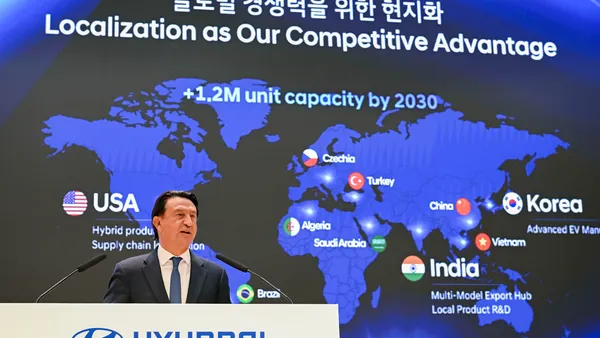
In response to U.S. tariffs, Honda plans to shift more production to U.S. facilities, including the manufacturing of the Civic hybrid car and CR-V CUV, to mitigate the impact of tariffs.
Additionally, Honda says it will postpone plans to build an electric-vehicle supply chain in Ontario, Canada, by approximately two years, citing slowing EV demand and uncertainty around the U.S. tariff economy.
Adding to U.S. Production
Honda has made significant investments in U.S. manufacturing in recent decades: 12 manufacturing plants producing automobiles, engines, transmissions, power equipment and aircraft employing approximately 30,000 across the U.S.
Honda recently invested $1 billion to retool three Ohio plants (Marysville Auto Plant, East Liberty Auto Plant, and Anna Engine Plant) for flexible production of internal-combustion-engine, hybrid and electric vehicles. In partnership with LG Energy Solution, the manufacturer constructed a $4.4 billion battery plant in Ohio to support EV production.
In response to U.S. tariffs, Honda is adjusting its production strategies, planning to produce the next-generation Civic in Indiana starting May 2028 and shifting from previous plans to increase manufacturing in Mexico. The manufacturer intends to increase U.S. production by 30% over the next few years to reach a target of 90% of U.S. sales produced domestically.