A clash of cultures and priorities scuttled the combination of Honda Motor Co. Ltd. and Nissan Motor Co. Ltd. earlier this year, but Trump Administration trade policies, and the capital requirements of developing software-defined vehicles (SDVs), are building bridges between the two companies.
Why Merger of Honda and Nissan Is Unlikely [Dec. 19, 2024].
The two Japanese automakers are exploring a new partnership focused on standardized vehicle software as well as looking at ways to optimize manufacturing facilities to reduce the impact of President Trump’s tariffs on Japanese-made vehicles.
Nissan and Honda have had a combined team researching new software tech since last year, when they started dating with an intent to marry via a merger that would have resulted in a new holding company Honda was slated to run. That work, reports Nikkei Asia, includes software-defined vehicles and a new infotainment platform to be used on both automakers’ next-generation models.
The two companies are looking to standardize key parts and systems, including semiconductors and motors, which are being developed in-house, according to Nikkei Asia. Honda reportedly believes the combined team has the chops to develop the software platform in-house, in contrast to Volkswagen Group, which dropped the idea of developing a software platform in-house and then entered into a partnership with Rivian, which is now building out the platform for VW’s future SDVs.
Both Nissan and Honda now have their own software platforms for current and near-future models but are working together to develop the next-generation platform that would probably see light of day around 2030.
Analysts are keen to see both companies increase their collaboration to spread costs and share capital investment. “If Honda’s hybrid cars are supplied to Nissan [and Mitsubishi], for example, the three companies would all be better off,” says Koji Endo of SBI Securities.
Shared Trucks and SUVs?
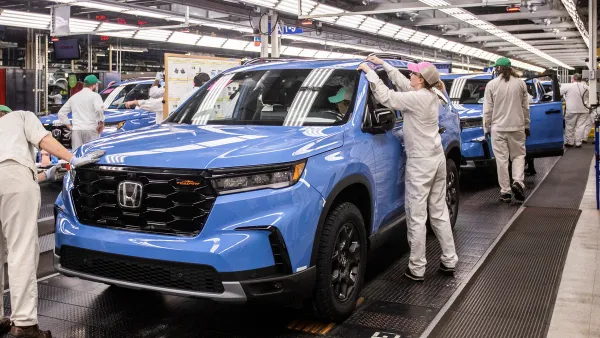
Separately, the two companies are talking about how Honda might tap some of Nissan’s excess capacity in the U.S. So far, reports Nikkei Asia, the talks focus on light-truck manufacturing of Hondas at Nissan’s Canton, MS, plant that turns out the Nissan Frontier midsize pickup truck, Murano midsize crossover and NV cargo and passenger vans, as well as the Altima midsize sedan.
What future products the two could share is an open question.
Honda’s current unibody Ridgeline midsize pickup truck would likely not be a candidate because Honda’s Lincoln, AL, plant is optimized to assemble that vehicle and three other models – Odyssey minivan, Pilot and Passport SUVs, all built on Honda’s Global Light Truck Platform, with a lot of shared parts and systems.
A new midsize truck, perhaps a version of the next-generation Frontier that could be badged a Honda. and perhaps an SUV spawned off that, are possible. Honda, however, has historically not been interested in body-on-frame vehicles, so the two companies would have to agree to jointly develop and retail a unibody model.
At press time, a Honda spokesperson had not yet responded to questions about the Nissan-Honda partnership.