Dive Brief:
- General Motors’ Audit Committee approved a $1.6 billion impairment charge on Oct. 7 as part of a strategic realignment of its electric vehicle manufacturing capacity owing to slower-than-expected demand, according to a Securities and Exchange Commission filing.
- The charges include $1.2 billion in non-cash impairments and $400 million in cash costs for contract cancellations and settlements related to the automaker’s previous EV investment strategy.
- In addition to slower-than-expected EV demand, GM cited recent changes to government policies, a rollback of emissions regulations and the Sept. 30 elimination of the federal EV tax credit as factors contributing to the impairment charge.
Dive Insight:
GM’s significant impairment charge highlights the auto industry’s vulnerability to sudden regulatory and policy shifts administered by the Trump Administration, including the impact of new tariffs on steel, aluminum and other auto parts that prompted GM and other automakers to reevaluate their supply chains. Earlier this year, GM revised its 2025 earnings guidance, which reflects an anticipated $4 billion to $5 billion impact in 2025 from tariffs on imported automobiles and parts.
GM also stated in its SEC filing that the reassessment of its EV manufacturing capacity, which includes battery component manufacturing in the U.S., is ongoing and may result in future cash and non-cash charges that may impact its revenue and cash flows. However, any changes to GM’s EV capacity will not affect the current retail portfolio of Chevrolet, GMC and Cadillac EVs currently in production. The automaker expects that these models will remain available to consumers.
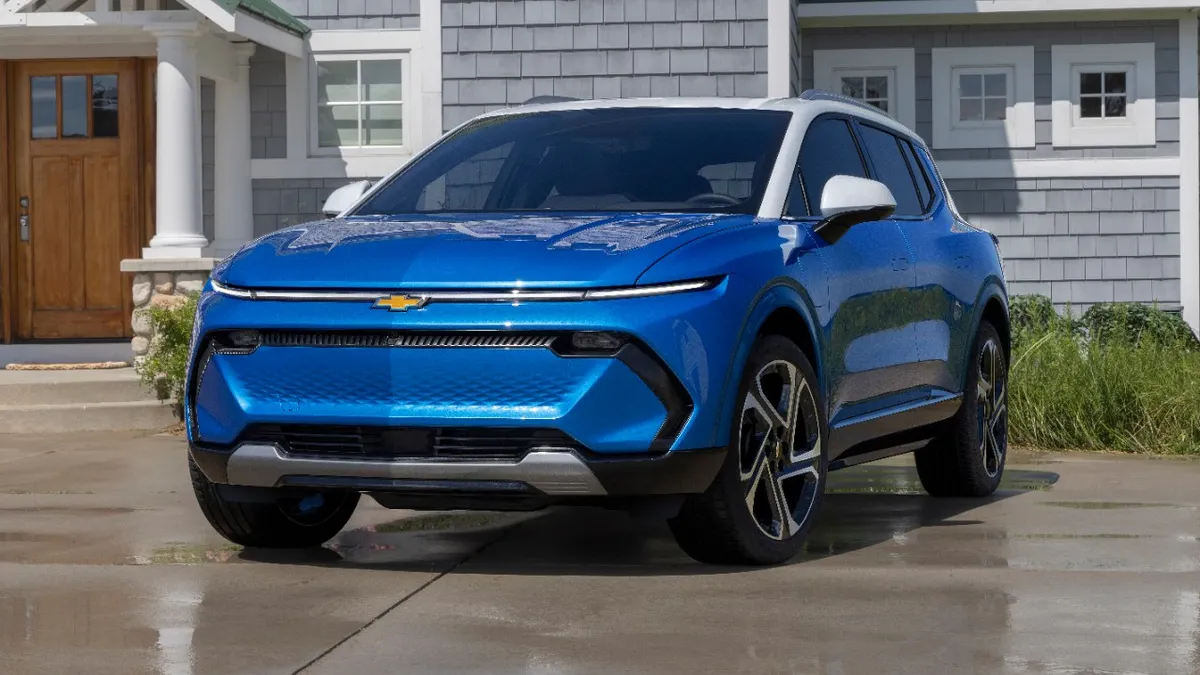
GM unveiled its redesigned Chevrolet Bolt on Oct. 9, with an MSRP of under $30,000, which may boost its appeal. The Bolt and Equinox EVs are expected to account for a majority of the brand’s EV volume in 2026, the automaker said in the release.
Previously, GM made significant investments in EV development to comply with emissions and fuel economy regulations that were scheduled to become increasingly more stringent through 2032.
In January 2022, GM announced it would invest $7 billion across four Michigan plants to expand production of battery cells and electric trucks. However, because of current market conditions, the automaker has revised those plans and is making investments to support production of its highly profitable truck and SUV portfolio.
In May, GM announced plans to invest $888 million in its Tonawanda Propulsion plant in Buffalo, New York, to support production of a next-generation V8 gas engine for its full-size trucks and SUVs. The planned investment is GM’s largest-ever commitment in an engine manufacturing plant.
In June, GM also announced plans to invest roughly $4 billion in its U.S. assembly plants in three states over the next two years, to boost domestic output of both gas and electric vehicles.
Looking ahead, GM expects its annual capital spending to be between $10 billion and $12 billion through 2027, reflecting its increased investments to boost its U.S. manufacturing capacity.
GM will announce its Q3 financial results on Tuesday, Oct. 21.