Dive Brief:
- General Motors on Tuesday reported a 55% decline ($3.3 billion) in year over year net income in 2025 from $6 billion in 2024 to $2.7 billion, which was primarily the result of $6 billion in electric vehicle-related charges in Q4, the automaker announced in its earnings report.
- Total revenue for the year was down 1.3% to $185 billion, despite a 6% increase in vehicle sales in the U.S. to 2.85 million vehicles. GM reported full-year adjusted EBIT of $12.7 billion for the year, falling short of its guidance between $13.7 billion to $11 billion.
- Despite market challenges related to tariffs and a decline in EV sales, GM forecasts adjusted EBIT between $13 billion to $15 billion in 2026 with margins between 8-10% as its pivots from EVs to building more profitable ICE vehicles.
Dive Insight:
GM’s total EV-related charges for 2025 were $7.9 billion, which significantly impacted its bottom line. The company reported an adjusted margin of 6.9% (down from 8% in 2024). However, unadjusted GAAP net margin fell to 1.5% in 2025, from 3.2% in 2024.
The EV-related charges of $6 billion in Q4 included $4.2 billion in cash for supplier settlements and contract cancellations related to its EV business and its pivots to building more profitable ICE vehicles. GM also reported a $1.6 billion in charge in Q3 related to retooling its Orion Assembly plant to produce more ICE vehicles.
“Looking ahead to 2026 and 2027 we expect to invest $10 to $12 billion annually, including approximately $5 billion to expand U.S. manufacturing capacity for some of the highest demand vehicles and further reduce our tariff exposure,” said GM CFO Paul Jacboson on the automaker’s earnings call.
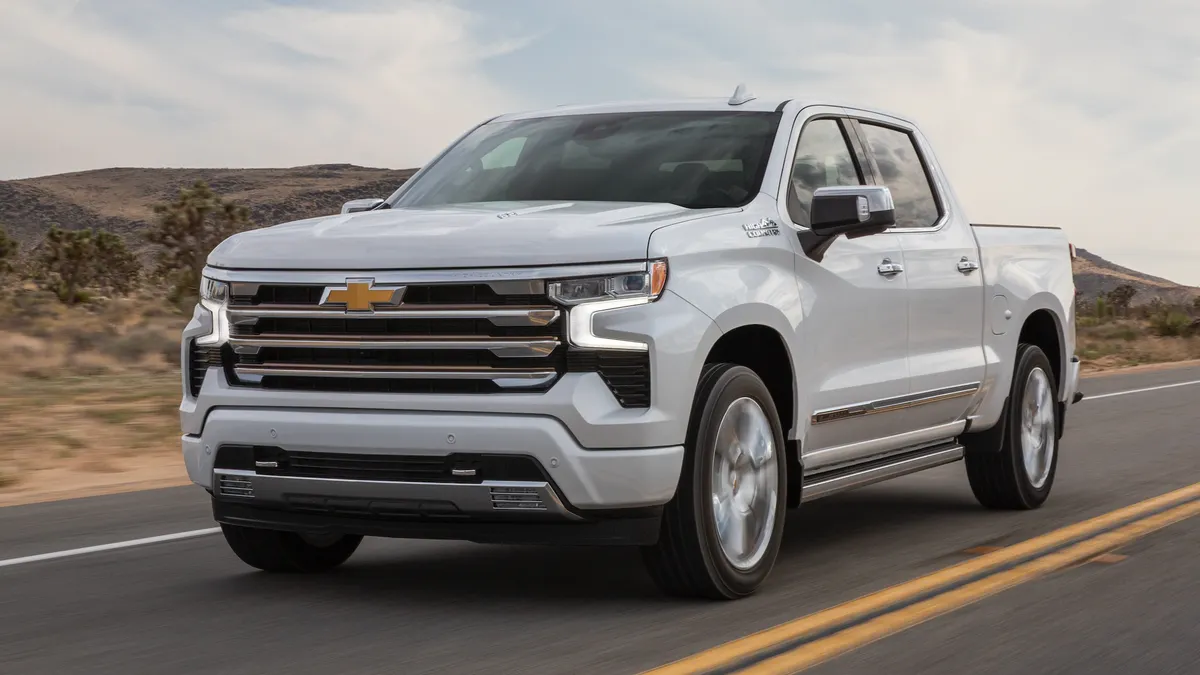
Still, sales of full-size SUVs and pickups were brisk in 2025. GM reported earlier this month that combined sales of GMC and Chevrolet pickups reached 940,000 units last year, a 7% YoY increase. It was the best combined sales of full-size pickups for the company in 20 years. GM anticipates that this momentum will continue in 2026 and beyond. The automaker expects that annual vehicle production in the U.S. will reach 2 million units in 2027.
“We are operating in a U.S. regulatory and policy environment that is increasingly aligned with customer demand,” CEO Mary Barra said in a letter to shareholders. “As a result, we continue to onshore more production to meet strong customer demand for our vehicles.”
Despite brisk sales of highly profitable ICE vehicles last year, GM remains focused on the growth and profitability of its EV business and part of its long-term business strategy. The plans include introducing new battery technologies, including lower-cost lithium manganese-rich (LMR) chemistries.
GM’s EV growth strategy also includes launching its next-generation software-defined vehicle architecture for both its EVs and ICE vehicles, expanding digital features, as well as launching new hybrid models in key segments. The new vehicle architecture is due to launch in 2028.
“We have not impaired our existing retail portfolio of EVs, we are working to improve the profitability of these vehicles through new battery technologies, engineering improvements and operational efficiencies,” Jacboson said on the earnings call. “We expect to achieve the necessary scale to deliver EVs profitably over time.”
GM also bought back $6 billion in stock in 2025 and the automaker’s board authorized an additional $6 billion buyback for 2026. It will help deliver shareholder returns as GM adjusts to market uncertainties in the EV segment that could impact its future financial performance.
Despite a downturn in the EV market for GM and other automakers in Q4, the company’s CEO remains committed to its long-term electrification goals.
“We continue to believe in EVs, and our portfolio brought almost 100,000 new customers to GM in 2025,” Barra said in the letter to shareholders. “We know these drivers do not often go back to gas, so we will continue executing our plan to reduce EV-related costs and we remain confident in our path to EV profitability.”