Editor’s note: John McElroy is the president of BlueSky Productions, which produces Autoline Daily, and a longtime opinion columnist for WardsAuto. Views expressed here are his own.
The auto industry is deep into an affordability crisis. It’s getting harder for Ma and Pa Middle America to afford a new car. And while Detroit is struggling to develop cars that cost less, General Motors and Ford are reluctant to take steps that could cut their operational costs and capital investments by billions of dollars a year.
How long can that go on?
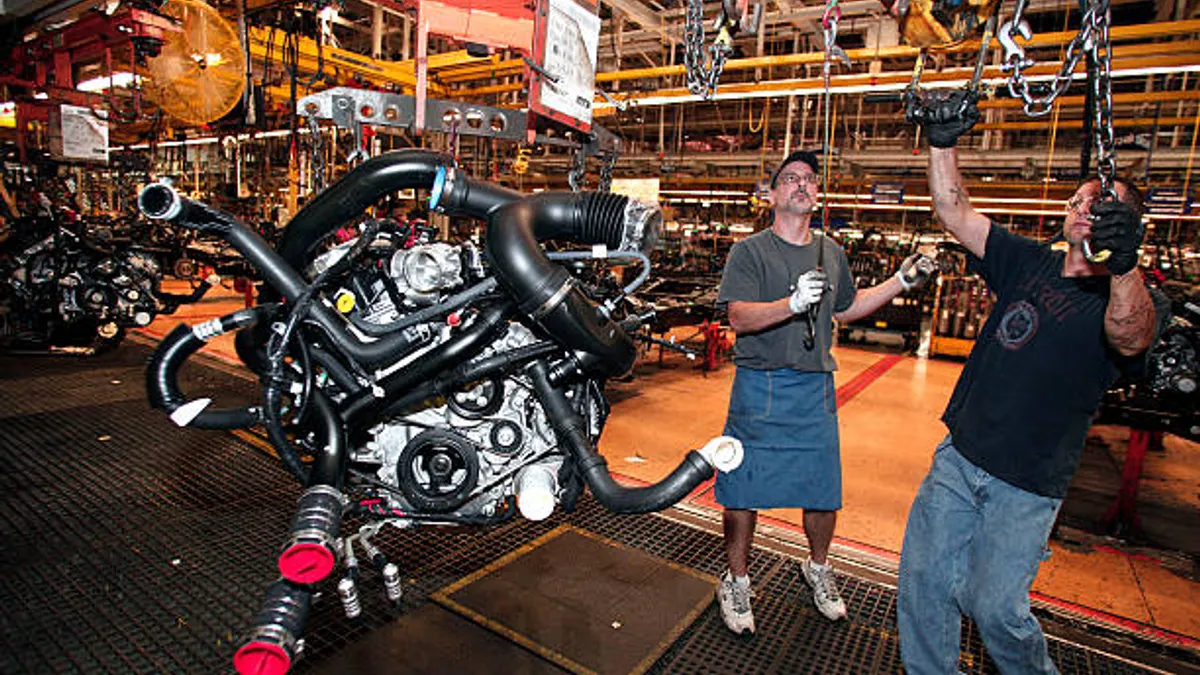
Every executive in the auto industry is familiar with the late Sergio Marchionne’s manifesto “Confessions of a Capital Junkie.” The former CEO of Fiat Chrysler (now part of Stellantis) pointed out that the Detroit Three all make engines that are virtually identical. They’re almost exactly the same size, generate the same horsepower and deliver the same fuel economy. Yet each automaker spends a fortune developing its own family of engines and tooling up its own engine plants.
Here's the kicker: Ninety percent of the car-buying public really doesn’t know or care what’s under the hood. That’s even more true of transmissions. Who buys a car because of its transmission?
The answer, of course, is nobody.
That’s why Marchionne suggested that GM, Ford and (then-) Fiat Chrysler should merge their powertrain operations and save a boatload of money in the process. That was in 2015 and of course nothing has happened — in fact, Ford and GM both rebuffed the idea — because spinning off the powertrain operations of a car company would be considered one of the gravest sacrileges a “car guy” could ever commit.
Yet, less than two years ago, Luca de Meo, then the CEO of Renault, decided to spin off his powertrain operations into a new company he formed called Horse. Geely, the Chinese automaker, liked the idea so much that it joined Horse. And since Geely owns Volvo, it got the Swedish automaker to dump all its engines and transmissions in Horse’s lap, too.
Today, Horse also makes engines for Mercedes, Nissan, and Mitsubishi and is letting everyone else know it’s open for business. Impressively, it’s already making 8 million engines a year which is giving it enormous economies of scale. Horse is now at the point where it can sell an engine to an automaker for less than the automaker can make itself. What’s not to like?
Spinning off powertrain operations is just one step. One of the ways the automakers in China hold down cost is by using a lot of common components — not just across their own vehicle lineups, but across the country’s auto industry.
Cars use a lengthy list of commodity components, such as windshield wiper motors, door hinges and tire pressure sensors. These components are virtually invisible to customers and have nothing to do with the brand image of a car. Yet strangely, many global automakers insist on designing their own.
China-based automakers largely don’t do that. They use common parts, and not just to cut cost. It’s part of their speed-to-market strategy. If they don’t have to design a part, then they don’t have to engineer it, or tool it up, or source it from a supplier. All they have to do is take it off the shelf and they’re done. This is one of the factors in those automakers’ ability to develop a new car in half the time it takes Detroit.
Of course, trying to commonize components will require a cultural shift. And any kind of powertrain spin-off would be mighty messy. The purists will be in anguish, the UAW will be on the warpath and engine engineers will fear for their careers. But to quote a famous line from history: “We lose by waiting.”
The American car market stopped growing nearly a decade ago. Car sales have flatlined despite a growing population. Automakers sold more cars in the year 2000 than they did in 2024, despite the fact that the American population grew by about 60 million people during that time frame. We’ve hit Peak Auto because millions of households are getting priced out of the new-car market.
There’s a golden opportunity for automakers to get back on a growth path, provided they come out with more affordable cars. If the same percentage of U.S. residents who bought a new car in 2000 had bought one last year, automakers would have sold 21 million new cars and trucks, not 16 million.
So the potential is there to sell 5 million more new cars a year. Five million! And all it’s going to take is a new way of doing business.