Dive Brief:
- General Motors aims to launch an “eyes-off driving” and bring conversational AI to its vehicles with the integration of Google Gemini in the coming years, the automaker announced at its “GM Forward” media event in New York on Wednesday.
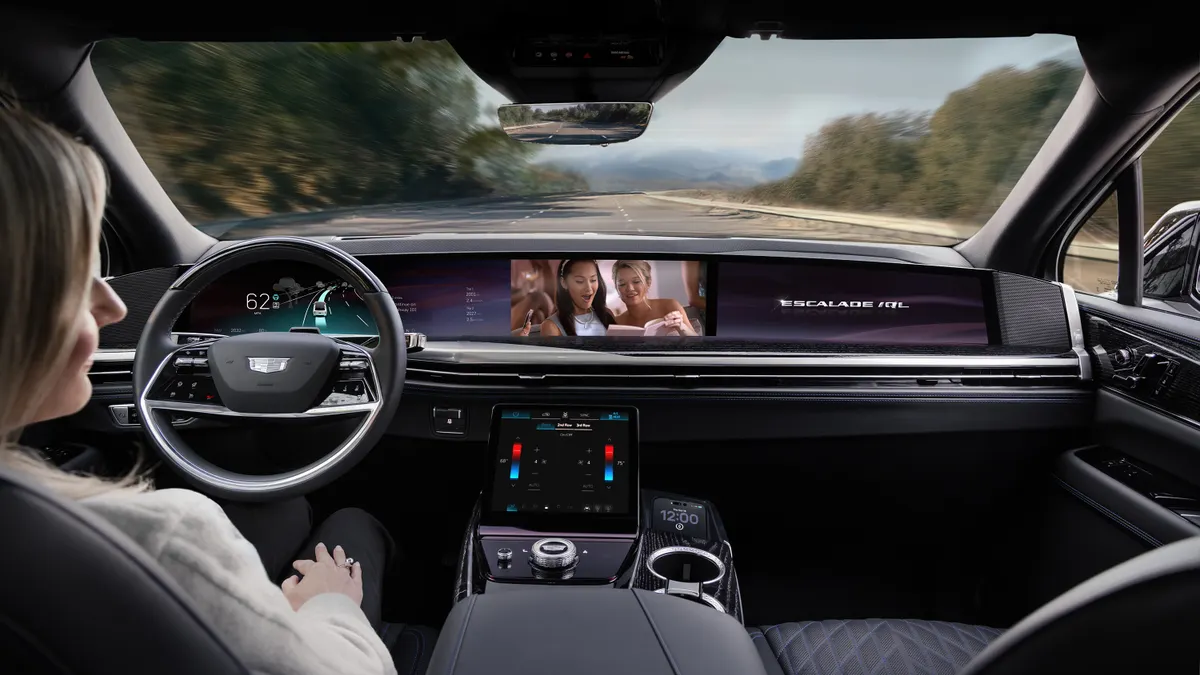
- The carmaker plans to offer the more advanced version of its Super Cruise hands-free driving system in 2028. The upgraded system will debut in the Cadillac Escalade IQ electric SUV.
- To support generative AI and a higher level of automated driving in future vehicles, GM also will adopt a new centralized computing platform starting in 2028. The software-based architecture bundles all of a vehicle’s core systems, including powertrain, steering, infotainment and safety, using a single, high-speed processor.
Dive Insight:
Perhaps the most ambitious plan GM announced Wednesday is the launching of an SAE Level 3 version of Super Cruise, allowing drivers to take their eyes off the road on pre-mapped roadways in North America. It’s a goal Tesla is also pursuing with its Full Self-Driving feature, which currently requires a driver’s full attention at all times when activated.
GM said it has already mapped 600,000 miles of hands-free roads in North America for Super Cruise. Per the company, customers have also logged 700 million miles with the hands-free driving feature activated, all without a single reported crash. The automaker’s Super Cruise technology was further validated by its former robotaxi unit Cruise, with over 5 million fully-driverless miles traveled by its fleet of Chevy Bolt EVs.
“This combination of technology, scale, a decade of real-world deployment experience, and safety systems developed and tested for Super Cruise gives us the foundation to deliver the next phase of personal autonomy,” the automaker said in a press release.
With the integration of Google’s Gemini generative AI in future GM models, planned for next year, drivers will be able to use natural conversational language to interact with their vehicles. In addition, the automaker says it will introduce its own version of generative AI that’s custom-built for each model. The feature will be fine-tuned to match the vehicle’s intelligence, as well to personal customer preferences. It will integrate with GM’s OnStar connected vehicle subscription service.
Meanwhile, the new computing platform will add 10 times more over-the-air software update capacity, 1,000 times more bandwidth and 35 times more AI performance to support autonomous driving and other advanced features, according to the release. The software-based system, which will be adopted for both internal combustion engine vehicles and EVs, will continue to evolve via over-the-air updates.
GM announced in March that it will use Nvidia’s Drive AGX platform for the development of advanced autonomous driving technology, vehicle hardware and AI-powered in-cabin experiences, including for vehicle infotainment systems.
The automaker also said in March that it’s adopting Nvidia's AI training software to make assembly line robots more efficient, as well as the chipmaker’s Omniverse 3D graphics platform to create digital twins of its factories and run simulations on virtual assembly lines to improve production efficiency.
GM said it assembled a team of 100 roboticists, AI engineers and hardware specialists to build advanced robotics systems trained on decades of vehicle production data. The goal is to create an AI-powered vehicle manufacturing system that learns and improves over time. The research is being conducted at the automaker’s Autonomous Robotics Center (ARC) in Warren, Michigan, as well as a sister lab in Mountain View, California.
“Through AI, advanced robotics, and a powerful computing platform, we’re creating a new generation of vehicles to deliver a personalized experience for every driver,” GM said in the release.