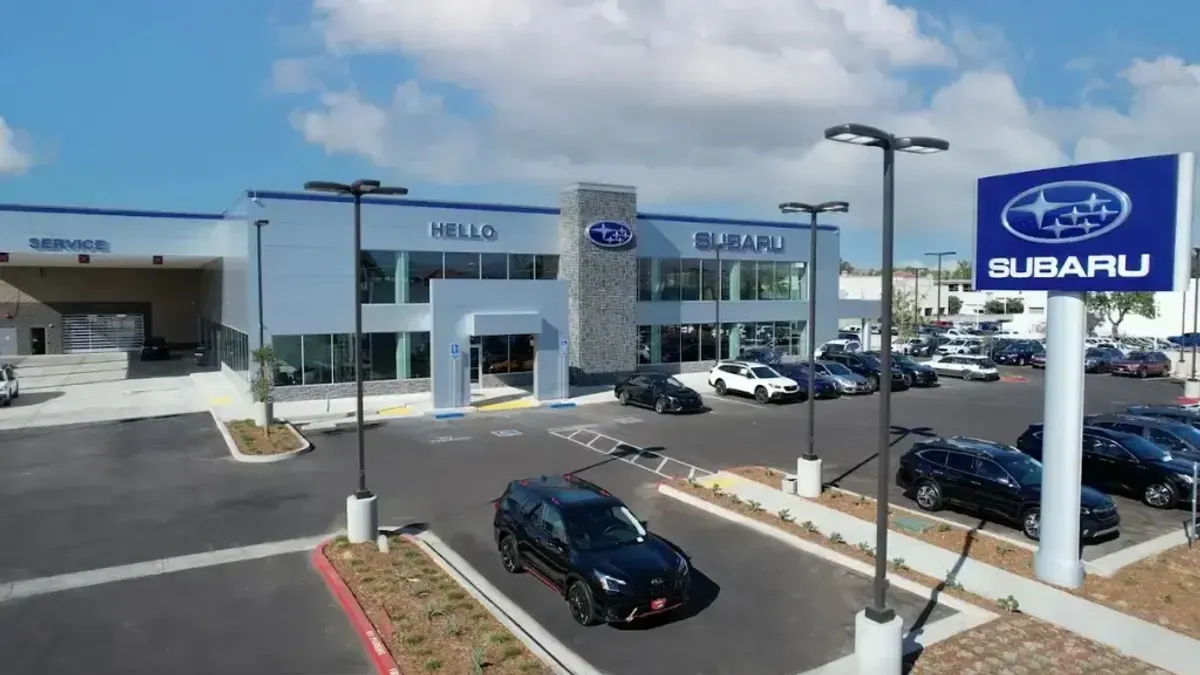
In March, Ghreiwati Auto Group acquired Hello Mazda and Hello Kia from the Hello Auto Group. Meanwhile, a different buyer is acquiring Hello Subaru, another dealership owned by Hello Auto Group. All three stores are located on the same street in an auto mall in Valencia, a neighborhood of Santa Clarita.
The complex transaction demonstrates how significant the role of the manufacturer is in any deal. It also shows how a fast-changing economic and regulatory environment is impacting the buy-sell market. For Ghreiwati Auto Group, acquiring the Mazda and Kia stores was an excellent fit, Rick Khan, operating partner of Ghreiwati Holdings, a conglomerate that owns multiple dealerships in Southern California, told WardsAuto in a phone call.
“We have an Audi dealership in that auto center,” Khan said. “We love the area.”
The deal closed on March 17, and the Mazda store is now known as Mazda of Valencia. The Kia store transaction closed on March 30.
A strategic divestiture
The Hello Auto Group is owned by a handful of investors including Karl Schmidt, the group’s president; Paul and Andrew Walser, owners of the Minnesota-based Walser Automotive Group, and a group of several dozen smaller investors, Jayson Crouch, managing director of Haig Partners, told WardsAuto in a phone call.
Haig Partners was the sell-side advisor to Hello Auto Group. Hello decided to sell the Santa Clarita group of dealers to concentrate on the three stores it currently owns in Southern California (two Mazda stores and one Subaru), Crouch said.
“This is a strategic divestiture to help them grow,” he said.
Haig Partners was hired to sell the dealerships in October 2024 and went to market in the Spring of 2025.
As it was working on an agreement with a potential buyer, the business atmosphere in the California market “dramatically improved,” Crouch said.
That included more stability regarding tariffs, which would have severely impacted Mazda’s many imported models, and a congressional resolution against enforcement of California Air Resources Board regulation mandating that 35% of model year 2026 light vehicles sold at California dealerships be fully electric, plug-in hybrid or fuel-cell vehicles.
That increased what the dealerships were potentially worth, Crouch said. Haig Partners advised Schmidt to “stay flexible and keep listening to the market as we saw a substantial increase in value come to the table,” Crouch said.
“2025 was a dynamic year for buy-sell activity in California, with demand and valuation strength building steadily as the year progressed, alongside greater clarity around CARB and broader industry conditions,” he said.
Another buy-sell firm enters the picture
A publicly owned auto group was interested in acquiring the Santa Clarita stores, but the deal was taking considerable time to close, the eventual buyer, Khan, told WardsAuto. Meanwhile, another buy-sell firm, the Dave Cantin Group, entered the equation. DCG had a long-standing relationship with Karl Schmidt and they discussed the Hello Auto deal on a catch-up call, Alex Covino, a managing director at DCG, told WardsAuto on a Zoom call.
“Karl asked for some assistance,” Covino said. “He gave me the chance to make that one phone call, and that one phone call was Sam Ghreiwati.”
Covino had known Sam Ghreiwati for three or four years, he said, which helped in identifying Ghreiwati Auto Group as a possible buyer.
A right of first refusal
DCG was under contract to sell all three stores to the Ghreiwati Auto Group, but the three sales required manufacturer’s approval of the buyer, as do all such transactions.
Subaru chose to exercise its right of first refusal and awarded the store instead to Chris Hemmersmeier, president and CEO of Utah-based Jerry Seiner Dealerships, Covino said.
A right of first refusal, or ROFR as it is commonly known in the buy-sell world, gives a manufacturer the right to refuse to sell a dealership to a buyer candidate and instead award it to the candidate of its choice, which in this case was Jerry Seiner Dealerships.
Thus, Jerry Seiner Dealerships ended up acquiring the Subaru store in a deal that closed on March 16, a day earlier than the Ghreiwati transaction.
The deal was complex, involving three dealerships, two buyers and one seller, Covino said. “The transaction took a deep understanding of the California market,” he added.
Changes coming
The Mazda dealership’s facility is “100% image compliant,” Khan said. With the Kia dealership, “we have committed to a timeline for the upgrade.”
Both dealerships have a lot of upside, he said.
“l like broken things,” Khan said. “The reason I am excited about these two deals is it really fits into my strategy.”
The Ghreiwati Group brought in a new general manager at the Mazda store and is planning some changes on the sales side, such as remaining open on Sundays.
It will also change from the prior owner’s one-contact sales process, where one person handles the entire sale including finance and insurance and closing, to a more traditional siloed sales process.
On the fixed ops side, the Group will bring in some practices that have proven successful at its other stores, which include four Nissan dealerships in Southern California.
At the Nissan stores, providing a complimentary six years of oil changes has given the dealerships very high customer retention rates, and that offer will be implemented at the Mazda and Kia stores as well, Khan said.
Easy turnarounds
Khan is optimistic about the future of the new acquisitions. Ghreiwati Auto Group has experience with turning around stores’ performance, given that it owns three Nissan franchises, all of which are doing well — now.
“Nissan hasn’t been easy,” Khan said. “The manufacturer has lost considerable market share. We have had to swim upstream.”
He is looking forward to owning the new stores in Santa Clarita.
“I can’t think of better franchises than Mazda and Kia,” Khan said. “I really do think this is going to be some of the easiest turnarounds.”