It’s a truism in the franchised, new-car industry that service retention falls sharply after cars and trucks are out of warranty, but it doesn’t have to be that way. And in some cases, new-car dealerships are seeing an increase in older vehicles returning for service, according to recent earnings reports from the six big, publicly held new-car groups.
Asbury Automotive Group, Duluth, GA, for example, reports the average mileage on the vehicles covered by its customer-pay repair orders increased to about 71,800 miles (115,600 km) in the first quarter of 2025, up from 68,900 miles (110,930 km) in 2022. At some Asbury dealerships, the average is 90,000 miles (144,900 km), David Hult, Asbury president and CEO, says during a recent earnings conference call.
“Supposedly, the franchised dealer loses the customer after warranty – well, this is well after warranty, and it shows we’re retaining it, and we keep getting it,” Hult says. “It’s not coming in huge chunks at once, but it’s slow, steady growth, which we think is smart because we want to retain the customers as well. So, we’re very focused on that.”
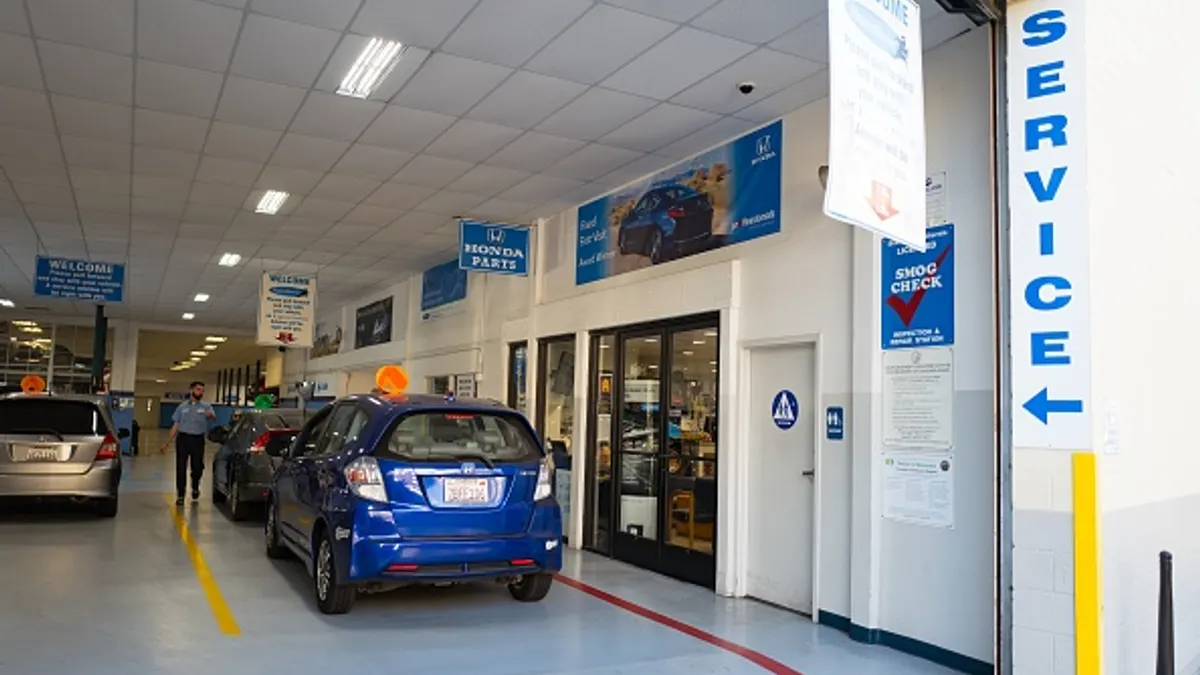
The increasing complexity of automotive electronics is a long-term trend that analysts say favors dealership service retention. To retain service customers, dealerships also increase the use of their existing service bays, add technicians, add service hours and in many cases switch to four-day work weeks that allow techs to work longer hours on few days.
As a group, the six publicly traded megadealer chains report parts and service revenue of about $4.4 billion in the first quarter of 2025, an average increase of 3.1% vs. the first quarter of 2024. The last two to report first-quarter results are Asbury and Penske Automotive Group, Bloomfield Hills, MI. Parts and service revenue numbers in this story are reported on a same-store basis.
Asbury’s parts and service revenue for the quarter is $587.5 million, up 1.5% vs. a year ago. Hult says bad weather disrupted dealership business in several markets in the first quarter, or else revenue would have been higher.
Separately, Penske Automotive says its parts and service revenue for its retail automotive segment is $764.6 million, up 4.2% vs. a year ago. That includes overseas dealerships, mainly in the United Kingdom.
High Margin
Across the board for the public companies, a significant increase in warranty work, driven by a rash of high-volume, high-value recalls, overshadows a smaller percentage increase in customer-pay work. Penske Automotive reports a 17% increase in warranty work in the first quarter, vs. an increase of just 1% in customer-pay.
Asbury says its warranty work increased 21% in the first quarter vs. a year ago, with an increase in customer-pay of 6%. Nevertheless, the increase in customer pay is significant. Customer ay is higher-margin than warranty and contributes the most toward both revenue and gross profit: at Asbury, 53% of parts and service revenue, and 63% of parts and service gross profit, in the first quarter.
Even with the increased warranty work, Asbury reports that warranty work contributes just 16% of parts and service revenue and 19% of the gross profit for the quarter. Dan Clara, Asbury COO says in the conference call, “We continue to be bullish on the long-term trajectory of our parts and service business.”