Very quietly, secretly even, a group of 400 people, including 150 engineers, have been developing a $27,000 electric pickup truck at a nondescript building in Troy, MI. The name of the company doing all this is Slate and at the very least, it’s going to become a case study for the auto industry in how to develop a low-cost vehicle.
First, the basics of the truck itself, then how it all came to be.
There are actually two models. There’s a 2-door, 2-passsenger pickup. And then, with a cap added to the pickup bed, it becomes a 2-door, 5-passenger SUV. There are two different bed caps, one with an upright backlite to accommodate more cargo, and one with a fastback to give it a sportier look.
The structure of the truck is a blend of body-on-frame, unibody and skateboard. Its high-strength steel frame is very stiff, with a 35 hertz bending moment. And Slate is using a lot of off-the-shelf parts to hold down cost and develop its truck more quickly.
To eliminate the cost of investing in a body shop in the assembly plant, Slate uses molded polypropylene body panels. And to eliminate the cost of a paint shop, the panels are not painted. Instead, customers will be offered different wraps that they can buy to apply to the body panels.
There are two different battery packs available: A 52.7-kWh pack that delivers 150 miles (242 km) of driving range, and an 84.3-kWh pack that delivers 240 miles (386 km). The truck is powered by a 201-hp motor, with 215 lb.-ft. (260 Nm) of torque.
It will accelerate from 0-60 mph (97 km/h) an hour in 8 seconds and top speed is 92 mph (148 km/h). It will carry a 1,400-lb. (635 kg) payload and can tow a 1,000-lb. (453-kg) trailer.
The overall length is 175.5 ins. (4,458 mm), which is about two feet (610 mm) shorter than a Ford Maverick. But the pickup has a 5-ft. (1,524-mm) bed, which is half a foot (152 mm) longer than the Maverick’s and it’s wider than the Maverick, too.
The interior packaging was actually inspired by the Chevrolet Bolt EV and is both roomy and safe. The truck is expected to get a 5-star and Top Safety Pick rating from NHTSA and IIHS, respectively.
Inside, it’s a bare minimum cabin. For example, while there is a small instrument cluster, there is no center screen. Instead, the dashboard has sliding mounting points for smartphones and tablets to serve as the center screen. Interestingly, Slate says customers will be able to get over-the-air updates for the powertrain controller via their smartphone.
There are lots of power connections around the interior for speakers and other plug-in devices. But there are no power windows. You crank them up and down by hand, just like in the old days.
There are three rotary knobs on the lower IP for HVAC, vent settings and fan speed. Speaking of HVAC, despite the bare minimum approach, air conditioning is standard equipment. And that’s it. Nothing else to clutter the dash.
Slate is actually the brainchild of two billionaires: Mark Walter, the CEO of Guggenheim Partners, and Thomas Tull, who, amongst other endeavors, started a company called Re:Build Manufacturing. They were motivated to do this project to achieve two goals: revive manufacturing in America, and make an electric truck that the average household can afford. Amazon Executive Chairman Jeff Bezos is also is an investor.
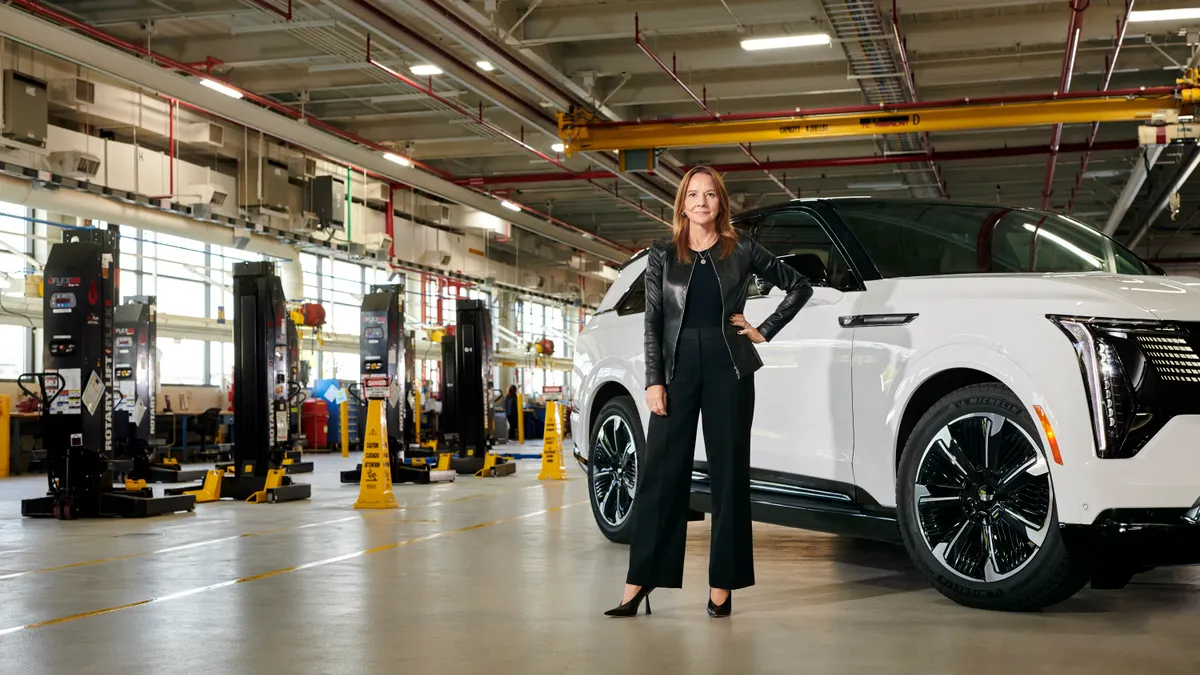
The CEO of Slate is Chris Barman, whose extensive automotive experience includes time at Chrysler as a vice president, and who ran multiple vehicle programs.
Eric Keipper is the head of engineering. He has far-reaching experience in vehicle integration with both traditional OEMs and EV startups.
Tisha Johnson is the head of design. Among other things, she spent a decade at Volvo in Sweden as vice president of interior design.
The chief commercial officer is Jeremy Snyder, who spent a decade at Tesla as the head of global business development.
These are people who know what they’re doing.
Their target customers are hourly wage earners, not early adopters. In fact, all the company’s advertising and marketing will be aimed at working-class people, not tech geeks or EV advocates. The idea is to give those wage earners a brand-new vehicle, with the latest safety equipment and a full warranty, rather than force them into the used-car market.
The company is even creating what it calls Slate University to teach owners DIY repair and maintenance to make the truck even more affordable.
To keep the price low, Slate is only going to build a basic truck, with nothing on it, and then offer all kinds of accessories to trim it out. It will offer wraps with different colors and patterns that customers can apply themselves, or hire someone to do it. There are also stickers that can be applied to the wheels to customize them.
Even the key fob can be customized. For example, the fob can be fitted with a built-in screwdriver that fits all the screw sizes needed to install the accessories. And Slate will offer plans for customers to 3D-print parts to customize their truck.
Part of the thinking behind this is that the second or third owners of the truck can put on their own wraps and accessories to give it their own personal look at very low cost.
One of the best aspects of this story is how Slate developed the truck. The company is run very frugally to keep overhead at a minimum. For example, when they saw that a company down the street was getting rid of a bunch of office chairs, they ran out and corralled them all to use in Slate’s offices.
Rather than build a beautiful corporate headquarters, they moved into an empty office building that an automotive supplier had abandoned. Their assembly plant in Warsaw, IN, is actually a giant 1.5 million sq.-ft. (139,355 sq.-m) warehouse that was sitting empty. And it’s tooled to make 140,000 trucks a year, whereas most truck plants are tooled to make 100,000 more than that.
To simplify the truck, they DFMA’d it. That is, they designed it for manufacturing and assembly. For example, their first iteration of the instrument panel design used 27 parts. They got that down to only seven parts. The door panels started out using 15 parts, and they got that down to 10. In fact, the entire truck is made from 500 different items to be shipped into its assembly plant, compared to the 2,500 parts shipped into traditional truck plants.
Slate did three separate virtual builds of the truck before it made the first prototype; most automakers only do one. And at its pilot plant near Detroit, which it used to build 72 prototypes of the truck, each vehicle was built up in exactly the same sequence that will be used in mass production. The idea was to catch any problems very early in the program.
Slate will go into production with its models in the fourth quarter of 2026. And it’s going to sell its truck and SUV directly to customers, not through franchised dealers. It’s in talks with several companies to handle distribution and service.
Here’s my take:. The company’s goals are admirable. The way it developed the truck is worthy of a business-case study. The truck itself will appeal to a lot of people. And the company will get a lot of attention.
But this business plan has two weak points: If the $7,500 government EV rebate goes away, then the base truck will cost more than a base Ford Maverick. Also, tooling the plant to make 140,000 trucks a year is pretty ambitious. After all, Ford only sold 130,000 Mavericks last year. And Maverick is a pretty popular truck from a proven brand.
Even so, in my book Slate is doing everything right. And I’m stunned that they were able to keep everything secret for so long.