Following several quarters of record-breaking sales in the U.S. market, Hyundai continues to push its electrified vehicle plans forward, including launching models under its battery-electric-vehicle sub-brand Ioniq.
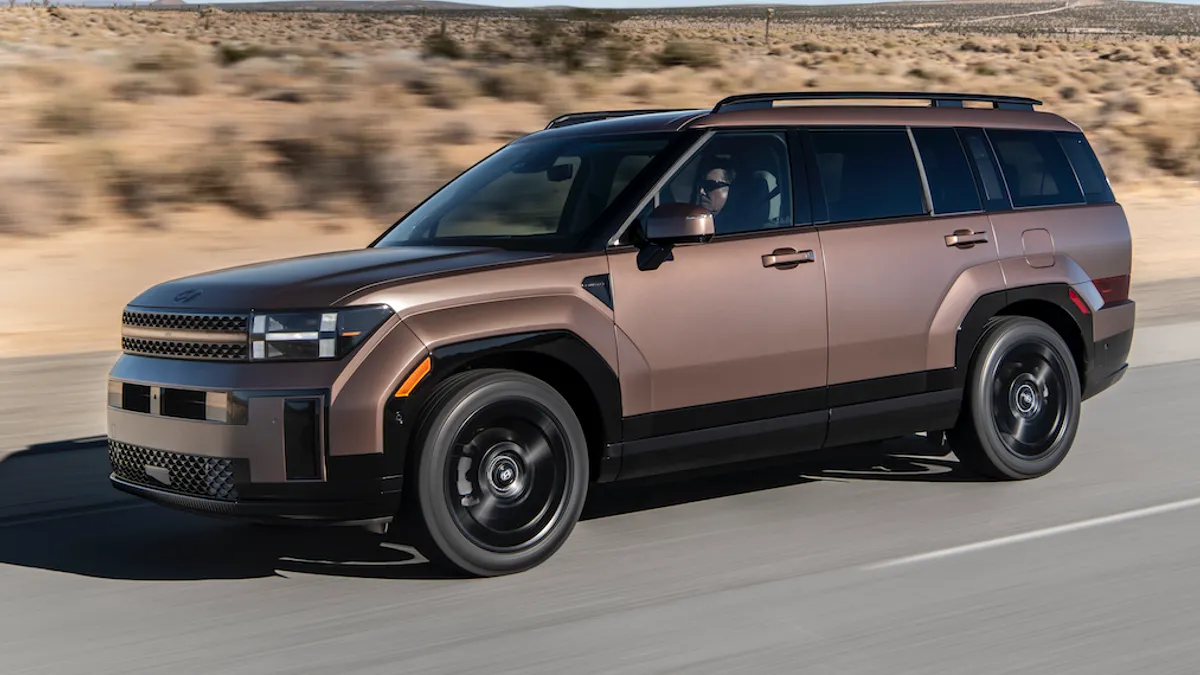
The sub-brand’s latest offering is the sleek Ioniq 9, the automaker’s first fullsize, 3-row electric SUV aimed at families looking for additional space in a BEV. The 2026 Ioniq 9 features many of the bold styling cues of the compact Ioniq 5, but Hyundai pushed the design envelope further for the flagship electric SUV, with unique interior and exterior styling details for the model, including a well-appointed and roomy cabin with plenty of storage space.
The new BEV’s exterior is designed to be as aerodynamic as possible and to reduce wind noise, which is a common issue for some BEVs with their near-silent powertrains. The result of the aero work is a low-drag coefficient of 0.27 Cd when equipped with digital side mirrors, which also reduces wind noise while helping to boost range.
A Wide Array of Power
All grades come with a hefty 110.3 kWh lithium-ion battery pack, the largest Hyundai offers in a BEV. Although official EPA-estimated ranges vary depending on the SUV’s specific configuration, Hyundai engineers targeted over 300 miles (483 km). The single-motor, rear-wheel-drive model has an estimated 335 miles (539 km) of range, while the top trim Calligraphy trim is good for up to 311 miles (501 km).
Since the Ioniq 9 is primarily intended to be a family hauler, Hyundai engineers dialed back the performance of its electric powertrain for most grades. The SUV is offered in base RWD, all-wheel-drive and Performance AWD drivetrains across the different available trims.
Power output varies widely depending on the grade. Compared to other BEVs, the SUV’s base long-range RWD models, not tested here but with a single 160-kw motor on back wheels, put out a conservative 215 hp and 258 lb.-ft. (350 Nm) of torque. However, that’s on par with many smaller internal-combustion-engine vehicles sold today, so the propulsion system should provide quick acceleration, but it won’t make you feel like riding in a sports car.
Meanwhile, the long-range AWD model comes with a 66-kW (90-hp) front motor and 160-kW rear motor, while Performance AWD models are powered by dual 157-kW (211-hp) motors for front and rear wheels.
Hyundai tweaks software to wring more power out of AWD variants equipped with dual motors, with the standard AWD variant rated at 302 hp and 446 lb.-ft. (605 Nm) of torque, while the Performance AWD version delivers 422 hp with 516 lb.-ft. (700 Nm) of torque. AWD models, like the top-of-the-line Calligraphy trim we drove, offer impressively quick acceleration when needed, but not overtly so.
Drive Impressions
Given its expected family-oriented buyer, the SUV has a softer suspension and light steering feel. Even when put into sport mode the propulsion system feels subdued compared to some other BEVs, although steering feel is tighter and the powertrain becomes a bit more responsive in sport mode.
Although the powertrain is tuned to be a bit more aggressive in sport mode, the SUV exhibited smooth and powerful handling on the highway in eco and normal modes.
When driven more aggressively, the vehicle tends to roll in corners and the electric power steering does not provide much feedback for the driver. The front suspension features a typical MacPherson strut, coil spring setup that’s more intended to soak up bumps rather than hug corners; the rear suspension is an independent multi-link setup.
Overall, the Ioniq 9’s AWD powertrain delivers a surprisingly good balance of performance as needed and seems well matched for a heavy SUV.
A Well-Appointed Interior
The top-trim Ioniq 9 Calligraphy model we test drive, winner of a 2025 Wards 10 Best Interiors & UX award, features a large panoramic sunroof, keeping the cabin airy and open and coming standard on higher trims, including the Limited, Calligraphy, and Calligraphy Design.
Seats are extremely comfortable with available heating and ventilation, including for the second row. “Relaxation Seats” with power recline, retractable leg rests and a “Dynamic Body Care” system with massage functions are offered.
Other interior features include a 12.3-in. (31-cm) instrument cluster display for the driver and a separate 12.3-in., center-mounted touchscreen display for navigation. The BEV’s climate controls feature traditional knobs and buttons that are easy to operate. An optional sunroof adds a spot of fun. Wireless charging and a slew of 100W USB-C ports make connectivity easy.
The center console cleverly slides backward and forward – up to 7.5 ins. (191 mm) – freeing up space for passengers or cargo.
Whisper Quiet Cabin
Engineers were challenged to keep the interior space as quiet as possible, employing acoustic laminated glass for the windshield and side windows to achieve the feat. Hyundai also adds its Road-Noise Active Noise Control (RANC) technology to the BEV SUV, which the automaker says was the world’s first when it debuted in 2020 models.
An 800V System Architecture, Native NACS Port
The Ioniq 9 is built on Hyundai’s Electric-Global Modular Platform (E-GMP). The dedicated electric vehicle platform uses an 800V system architecture, which enables ultra-fast charging. As with the Ioniq 5 and 6 models, the BEV can handle both 400V and 800V charging currents without the need for a separate adapter thanks to inverter technology – helpful given the U.S.’ current mix of older, slower public DC fast-chargers and newer ultra-fast units.
A native NACS port, debuting on Hyundai BEVs this year, gives Ioniq 9 buyers access to 17,000 Tesla Superchargers. It takes approximately 41 minutes for the battery pack to go from 10% to 80% charged when plugged into one of Tesla’s more powerful V3 Superchargers, Hyundai says. However, when using a 350-kW DC fast charger from rival charging networks, along with the Hyundai-supplied NACS-to-CCS adapter, charge time is an estimated 24 minutes.
Level 2 AC charging at home takes approximately 9 hours and 40 minutes to reach the same 80% charge, but with overnight charging commonplace, the nearly 10-hour charging time shouldn’t be too egregious for owners.
For locating public chargers, Hyundai integrates the ChargePoint network into its Blue Link-powered infotainment system, but Ioniq 9 owners can also access the growing IONNA charging network, a joint venture of seven automakers, including Hyundai and its sister company Kia.
The U.S.-built Ioniq 9, assembled at Hyundai’s new Metaplant near Savannah, GA, is eligible for the federal tax credit of up to $7,500, which can be applied at point of sale. However, the credit is set to expire on Sept. 30.
Pricing
Pricing for the base RWD model starts at $60,555, including destination, while AWD Performance Limited starts at $72,850, also including destination. The top-trim AWD Performance Calligraphy starts at $76,590 and tops out at $78,090 with optional matte paint and larger 21-in. turbine wheels.
Hyundai currently is offering 1.9% financing for up to 60-months on the Ioniq 9. In addition, customers that purchase or lease a 2026 model are eligible for either a Home Flex Level 2 residential charger from ChargePoint or a $400 charging credit towards public charging sessions.
The Ioniq 9 is on sale now at U.S. Hyundai dealers.