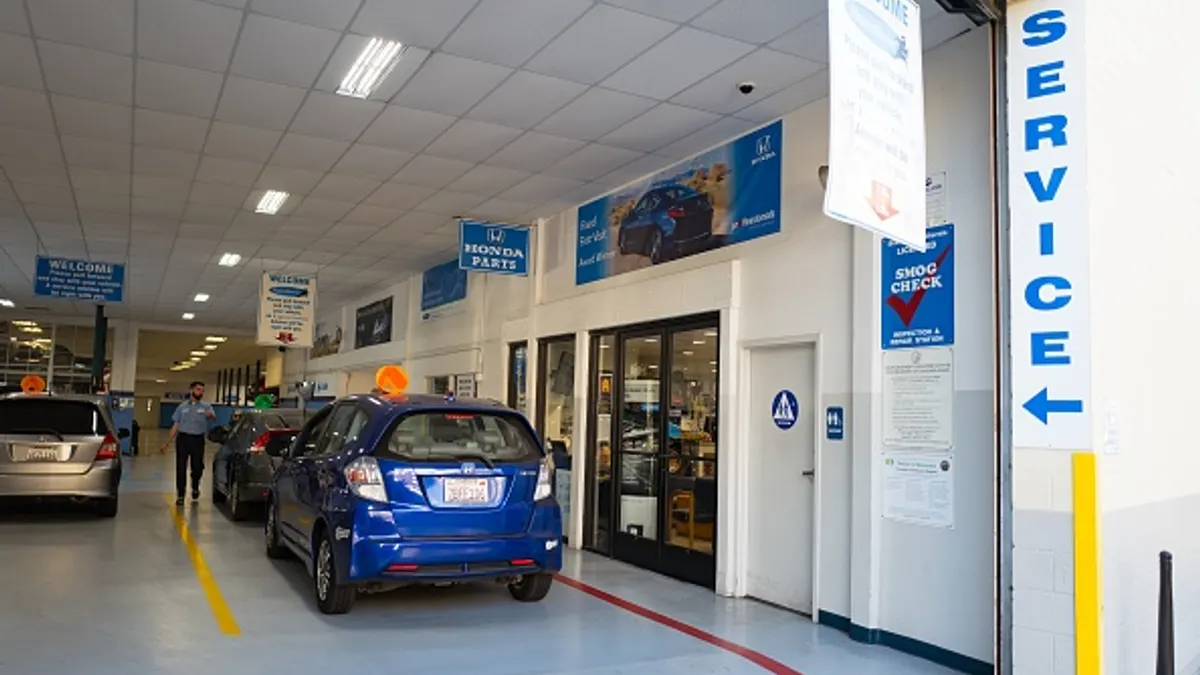
To offset lower new-car margins and shakier new-car demand, dealer groups are shopping for stores, especially luxury-brand stores, with a track record of strong fixed operations, according to dealership buy-sell brokers.
“We always talk about brand and geography – and we still do – but there’s a third lever for the store as well, and all that ties back to the fixed ops opportunity,” says George Karolis, president of the Presidio Group.
Presidio is an independent merchant banking firm focused on dealership mergers and acquisitions, with offices in the Denver and Atlanta metro areas. The fixed ops opportunity is especially true for luxury brands, Karolis says in a phone interview.
Luxury brands have far fewer U.S. dealerships than mass-market brands, fewer same-brand competitors in the same market and a large number of units in operation, which represent potential service and parts customers, he says.
“There’s been a flight to quality,” in the buy-sell market, Karolis says. “Overall, it’s still a sellers’ market, certainly, but there’s a trend to buyers desiring larger-volume, luxury stores in particular.”
Aiming High
In June, Presidio announced it facilitated the sale of two Mercedes-Benz dealerships to megadealer group Lithia Motors of Medford, OR. The dealerships are Mercedes-Benz of Jackson, MS, and Mercedes-Benz of Collierville, in suburban Memphis, TN, “Both have really strong fixed operations,” Karolis says.
They are Lithia’s first Mercedes-Benz dealerships in its growing Southeast region. The sellers are Trudy Higginbotham Moody and Wallis Higginbotham – daughters of the late founder of the family business, Dennis Higginbotham – plus other family members, according to Presidio.
“These acquisitions align with our strategic focus on growing in high-performing regions and strengthen our luxury brand portfolio,” says Bryan DeBoer, Lithia president and CEO, in an announcement after the sale closing. In an earlier conference call to review first-quarter earnings, DeBoer says Lithia is targeting “larger automotive retail stores and the stronger profitability regions of the Southeast and South Central United States.”
Upscale Move
Meanwhile, another megadealer group, Sonic Automotive of Charlotte, NC, this month reports that it bought four California dealerships, making Sonic the largest-selling Jaguar Land Rover retail ownership group in the United States.
The newly acquired dealerships are Jaguar Land Rover Los Angeles, Jaguar Land Rover Newport Beach, Jaguar Land Rover San Jose and Land Rover Pasadena. Sonic says that together, they represent approximately $500 million in annual revenue. The seller is Los Angeles-based U.S. Auto Trust, a dealership group founded by Ed Glazer.
Besides those four stores, Sonic’s website says it also has three Jaguar Land Rover dealerships in Texas, and three more Land Rover stores, one each in Georgia, Colorado, and Alabama.
Sonic Automotive already has a big presence in California, including many high-end dealerships, says David Smith, chairman and CEO, in a phone interview. As of March 31, 2025, Sonic reports it had a total of 108 dealerships in its franchised dealership business segment.
Diversification
Without referring to individual stores, Smith says he agrees that there’s a trend in auto retail to put a higher priority on fixed operations. He says Sonic hired a net additional 335 service technicians in 2024. Smith says, “We have a big focus on fixed operations.”
Jaguar Land Rover North America of Mahwah, NJ, says separately that it has 105 full-service Jaguar locations, plus some service-only points and 202 full-service Land Rover locations. Many of the full-service Jaguar and Land Rover points are dual.
High Margins
Erin Kerrigan, founder and managing director of buy-sell firm Kerrigan Advisors, says diversification is an important hedge against ups and downs in new-vehicle sales.
“One of the unique strengths of the dealership business model is its diversification. In times of softening vehicle gross margins, dealers are able to lean on the stability and recurring fixed operations segment of the business,” she says.
Margins on fixed ops are historically about nine times higher than new vehicles, and in 2024, fixed operations represented 43% of total gross profit for the big, publicly-traded dealer groups, Kerrigan says.
“Fixed operations have proven their ability to sustain most economic challenges given their high margin nature,” she says.