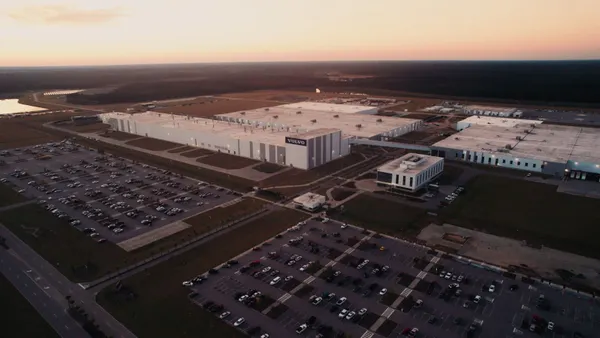
Chery is reportedly close to finalizing a deal to produce vehicles for its new Lepas brand at one of Volkswagen’s manufacturing facilities in Germany.
The plan, first floated earlier this year when VW confirmed it would wind down operations at its German plants in Dresden and Osnabrück as part of a broad cost-cutting effort, would mark a major step in Chery’s strategy to expand its European footprint.
It would also give the Chinese automaker a manufacturing base in Europe’s largest car market and a potential path to sidestep European Union tariffs on electric vehicles imported from China.
Chery confirms to Wards Auto that discussions about production in Germany are ongoing, although it stops short of naming Volkswagen directly.
Speaking at a recent media event in China, Charlie Zhang, vice president of Chery International, says the company is conducting a feasibility study but warns that Germany’s labor, cost and regulatory conditions present significant challenges.
“In Germany, the situation is very, very complicated,” Zhang says, citing unresolved issues around supply chains, labor laws, operational costs and compliance requirements.
It’s still unclear whether Chery is looking to lease or buy one of VW’s idled facilities. However, VW’s decision to scale back domestic production has created an opportunity for Chinese carmakers to step in – a move German labor unions see as a way to preserve jobs while reviving unused industrial capacity.
If a deal is signed, the plant would likely produce vehicles for Lepas, Chery’s newly launched international brand built around reworked SUVs from its Tiggo lineup. Three models have been confirmed for Europe – two compact SUVs and one midsize SUV – with battery-electric, plug-in hybrid and internal-combustion-engine options. Sales are expected to begin in 2026.
Chery Already in Nissan Spain Partnership
Chery already operates a European manufacturing base through a partnership with Spanish company Ebro at a former Nissan plant in Barcelona. That facility currently builds the Tiggo-based Ebro S700 plug-in hybrid but will expand later this year to include EVs from Chery’s Omoda and Jaecoo brands.
The Barcelona site has an annual production capacity of up to 200,000 units. Zhang says Chery is boosting European component sourcing at the plant to meet European Union content thresholds and reduce exposure to tariffs on Chinese-built electric vehicles.
“Our target is to reach at least 50% non-China content,” he says, adding that sourcing batteries outside China is a key part of the strategy.
Chery has aggressive growth plans for Europe. The company aims to expand Omoda and Jaecoo’s reach to 19 countries by the end of 2025, up from seven currently, with market launches in Germany and France already in the pipeline.
VW is targeting over €15 billion ($16 billion) in annual cost savings as part of its German production restructuring initiative announced in December 2024. The so-called “Future Volkswagen” plan includes €1.5 billion ($1.6 billion) in labor cost reductions through the elimination of more than 35,000 jobs across its German operations by 2030. It also plans to scale back production capacity by over 700,000 units per year across its German plant network.
Founded in 1997 and headquartered in Wuhu, Chery has been China’s top passenger car exporter for 22 consecutive years. In 2024, it recorded global sales of 2,603,916 units, a 38.4% increase over 2023. Export sales totaled 1,144,588 units while new energy vehicle sales – a category encompassing BEVs, PHEVs and extended-range electric vehicles (EREVs) –, including all-electric vehicles, plug-in hybrids and range extenders, totalled 583,569 units.