Editor's note: This article was originally published in Automotive Dive, which has merged with WardsAuto to bring you expanded coverage of the industry. For the latest news, sign up for our free, daily newsletter.
Dive Brief:
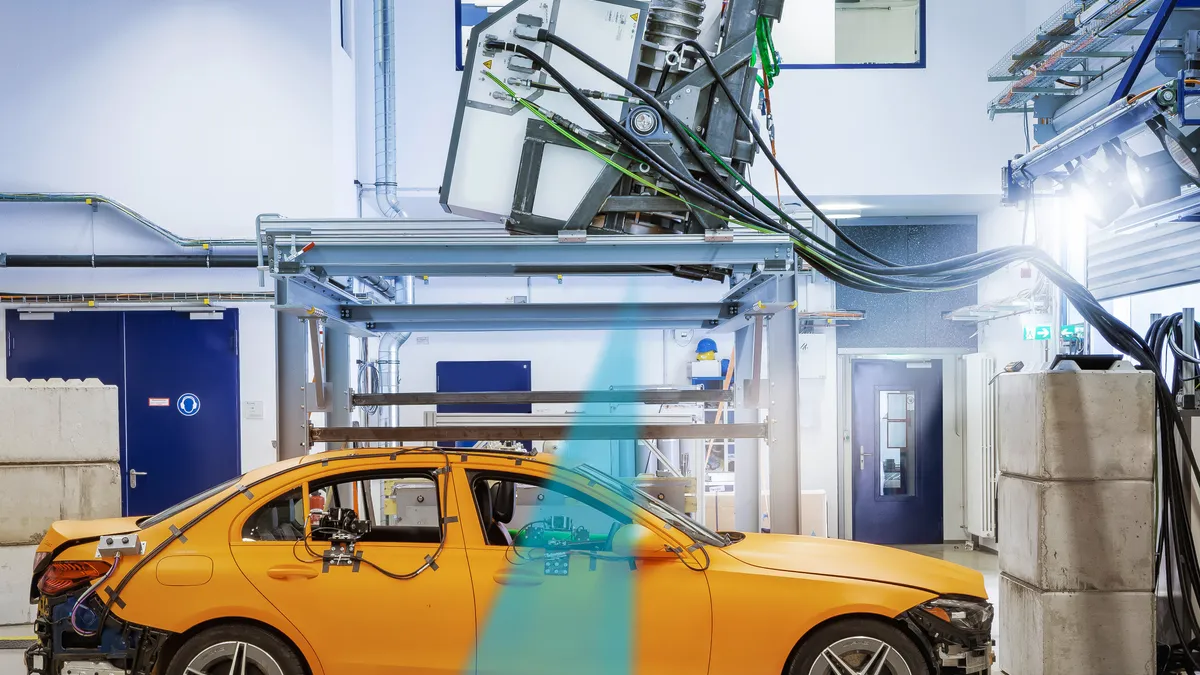
- Mercedes-Benz has become the first automaker to use high-speed X-ray technology to evaluate how its vehicles perform in a crash test, according to a March press release.
- The technology allows the automaker to capture up to 1,000 high-resolution images per second to analyze how vehicle body structures deform in a crash and protect test dummies more precisely.
- The automaker plans to use the technology to improve vehicle safety now that it’s established proof of concept.
Dive Insight:
Features like crumple zones, airbags and active seat belts have made vehicles safer. However, these systems rely on a vehicle’s body structure to help protect occupants during a crash, which makes it essential for automakers to improve how their vehicles’ bodies deform in a collision.
“The Mercedes-Benz X-ray crash sets a milestone in the development tools of the future,” said Markus Schäfer, Mercedes-Benz’s chief technology officer and a company board member, in the release. “With a direct view into the hidden interior, it can help to draw important conclusions for the further improvement of vehicle safety.”
Mercedes-Benz conducted the 60 km/h (37 mph) crash test in collaboration with the Fraunhofer Institute for High-Speed Dynamics, commonly known as the Ernst Mach Institute, in Germany. Researchers carried out the test with a C-Class sedan, using a more powerful linear accelerator as the radiation source for the X-rays to provide more detail than the conventional X-ray technology used in previous experiments.
During the test, X-ray beams are directed through a vehicle’s body and test dummies from above. A flat detector placed under the vehicle serves as a digital receiver for the X-rays. Each X-ray pulse lasts just a few microseconds, allowing the automaker to capture the deformation process during a crash test without motion blur.