

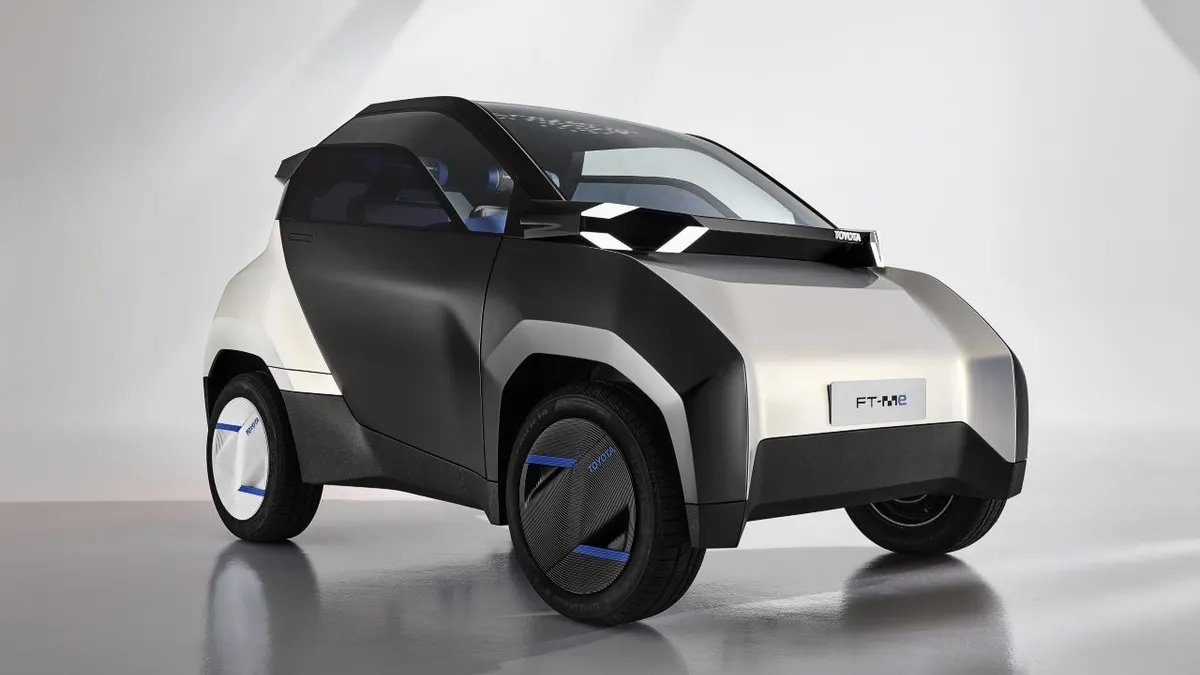
A Toyota-led micro-mobility consortium received £15 million ($20 million) in funding from the U.K. government that could lead to the launch of an electric rival to Citroën’s Ami micro quadcycle.
The funding will aid a commercial feasibility study into the FT-Me Toyota concept to produce a vehicle that complies with the L6e light quadricycle class of vehicle, the automaker said is a company release.
Quadcycles are limited to a power output of 8 bhp and a top speed of 28 mph. They can be operated by individuals as young as 16 with the lowest level of driving license to operate mopeds and quadcycles, or by anyone with a full motorcycle or car driving license.
The funding is provided through the Advanced Propulsion Centre’s DRIVE35 program, which was allocated £2.5 billion ($3.34 billion) for the DRIVE35 initiative. Its goal is to help automakers boost the transition to zero-tailpipe emissions and is awarded to organizations committed to funding at least 50% of the project’s total cost.
As such, a statement released by the government estimated the overall project will amount to a public-private investment of £30 million ($40 million).
Toyota Motor Manufacturing U.K. expects the feasibility study to give the green light for commercial production of its quadcycle at its TMUK’s Burnaston facility in Derby, its statement read.
Joining the automaker in the consortium are ELM Mobility and Savcor. ELM will study the platform and components to reduce dual development and create economies of scale. While Savcor will apply its expertise to develop a photovoltaic lightweight integrated roof design used to create its solar-roofed last-mile delivery vehicle with a daily range of 19 miles.
Toyota hopes to help refine the technology sufficiently, improving performance by up to 20% to create a vehicle that can be used daily for urban journeys without the need for daily battery charging, its release said.
Finally, the University of Derby will combine academic research with public sector strategy and private sector innovation to address how integrated mobility solutions can align with existing and planned transport strategies.
“The funding allows us to advance our understanding around the feasibility of creating a cutting-edge battery electric vehicle that addresses the growing demand for sustainable urban mobility,” said Dariusz Mikolajczak, TMUK managing director.