Ford Motor Co.’s efforts to improve vehicle quality over the past several years are starting to bear fruit.
The company has earned the top spot in JD Power’s 2026 U.S. Initial Quality Study among mainstream brands, marking the first time since 2010 that the automaker gained the title.
Ford said in a company press release it improved its quality in nearly every vehicle category measured by JD Power, including powertrain reliability.
Thomas King, president of OEM solutions at JD Power, noted that the Ford F-150, Mustang and Ford Super Duty also ranked highest in their respective segments for the second consecutive year.
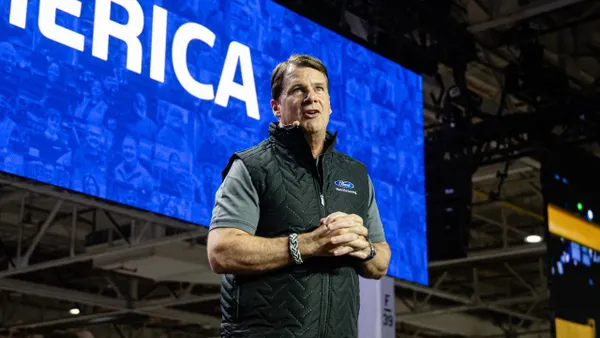
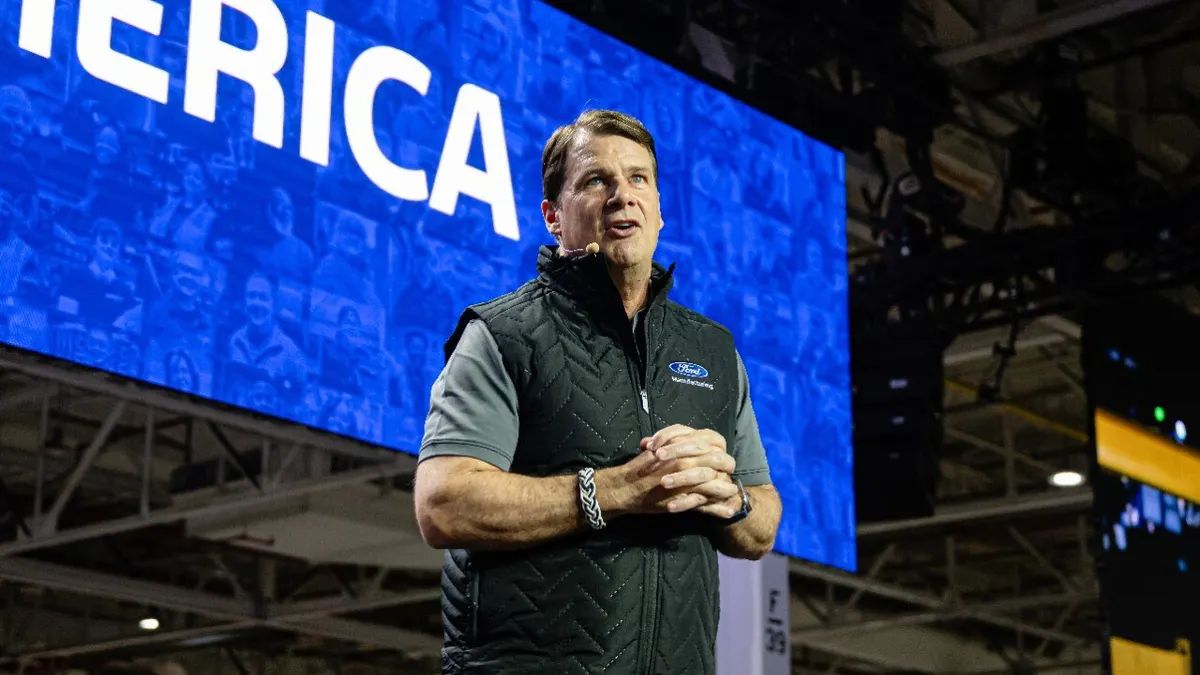
“This is a proud day for everyone at Ford, and the result of years of intensive work across our company,” President and CEO Jim Farley said in a statement. He said during yesterday’s media briefing that Ford has prioritized quality “at the CEO level” for the last several years.
Combining teams pays off
Ford’s ascent to the top spot comes just three years after it ranked No. 16 in JD Power’s initial quality rankings.
That same year, in 2023, Ford created an Industrial System team in which vehicle engineering, manufacturing, supply chain and quality teams work together under one organization, according to a company press release published after JD Power revealed its study Thursday.
Since its creation, Ford’s Industrial System team, led by Chief Operating Officer Kumar Galhotra, has worked to break silos between internal teams to find and fix quality issues before they reach customers. This year, the team evolved to become Ford’s new end-to-end Product Creation and Industrialization organization, bringing together the automaker’s digital, design and global industrial teams.
“Bringing them together allows us to look at the entire ecosystem of a vehicle, from the intricacies of software development to the deepest tier of the supply chain to the plant floor, as one continuous, collaborative flow,” Galhotra said in a statement. “We rallied the whole company around a clear vision: Quality Comes First.”
Improving software improves results
Much of Ford’s efforts to improve quality focus on vehicle software, where a “fix it later” approach does not work, especially for safety-critical vehicle systems. During a media briefing Wednesday, Ford executives said the automaker established an internal software test team to stress-test software to its “absolute limits.”
“Therefore, in the last 18 months, we stood up a dedicated 40-person software quality assurance team, a group that didn't even exist before,” Charles Poon, Ford’s VP of vehicle hardware engineering, said in the media briefing. “Their entire mission is just to scrutinize the system preventively, look for errors and cracks in communication and handoffs, and build in the quality from day one, rather than just reacting."
Poon said Ford’s vehicle software evaluations include 100,000 new automated tests that look for edge cases. While these are rare occurrences, a vehicle’s software must be able to deal with all unexpected driving scenarios to maintain a high level of safety, he said.
Ford also overhauled its software quality assurance. Before any code reaches a vehicle, it’s stress-tested through hundreds of thousands of automated scenarios designed to simulate unpredictable, real-world use, according to Ford’s press release.
“Software needs to be stress tested to its absolute limits, just like hardware, because these tests are highly automated,” Poon said. “Even if we have a late change in the software, we can rapidly run back through the entire validation process to guarantee it works perfectly well before it reaches the customer.”
Enhanced mechanical testing provides protection
Outside of software, Ford has boosted mechanical testing of engines and other vehicle components to help prevent defects being passed along to customers.
Poon said Ford used to tear down an engine once every three months at its Essex engine plant in Ontario, Canada, which produces the 5.0-liter V8 for the F-150 pickup. Now the automaker says it conducts engine teardowns daily, pairing up veteran engineers with newer mechanics to ensure that the corrective learnings from past issues are passed down.
“If we find even a slight issue during a teardown, we hold that day's shipment until we know it's perfect,” Poon said.
Poon said Ford looked at connected-vehicle data and realized the company needed to “move the bar mathematically” to prove its powertrains will last and implement more rigorous test procedures.
“My team of 8,000 engineers is designing and testing to a new standard, the equivalent of 15 years or 225,000 miles. We're learning to celebrate and embrace failure,” Poon said.
AI plays a role
Ford also adopted new AI-powered inspection technology at its assembly plants, which is used to evaluate engine mechanical components, among other examples. Poon said Ford collects hundreds of data traces from its hot engine tests to spot microscopic differences, which he said is nearly impossible for a human inspector.
The AI analyzes millions of points from engine test stands. Even if a part is technically within specifications, the AI can find tiny anomalies compared to the thousands of engines assembled before, according to Poon.
“If we find those anomalies, we pull it [the engine] and we go through our problem solving,” said Poon.
Ford's focus on improving quality is also helping the company reduce warranty costs. Galhotra said in Wednesday’s media briefing that Ford recorded lower year-over-year warranty costs in 2025 and expects that trend to continue through this year.
“Thanks to better engineering, improved manufacturing, the vehicles that are rolling off line today are among the highest quality in our history,” Galhotra said. “This operational excellence enables the paths for continued financial improvement.”