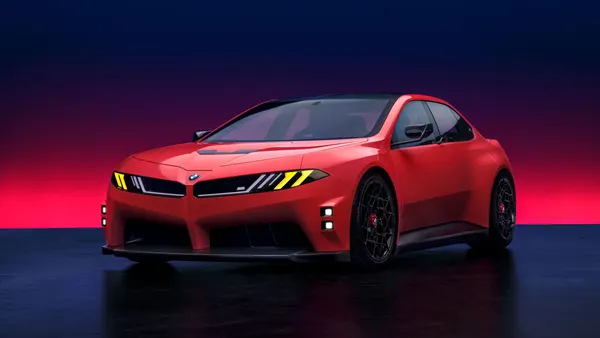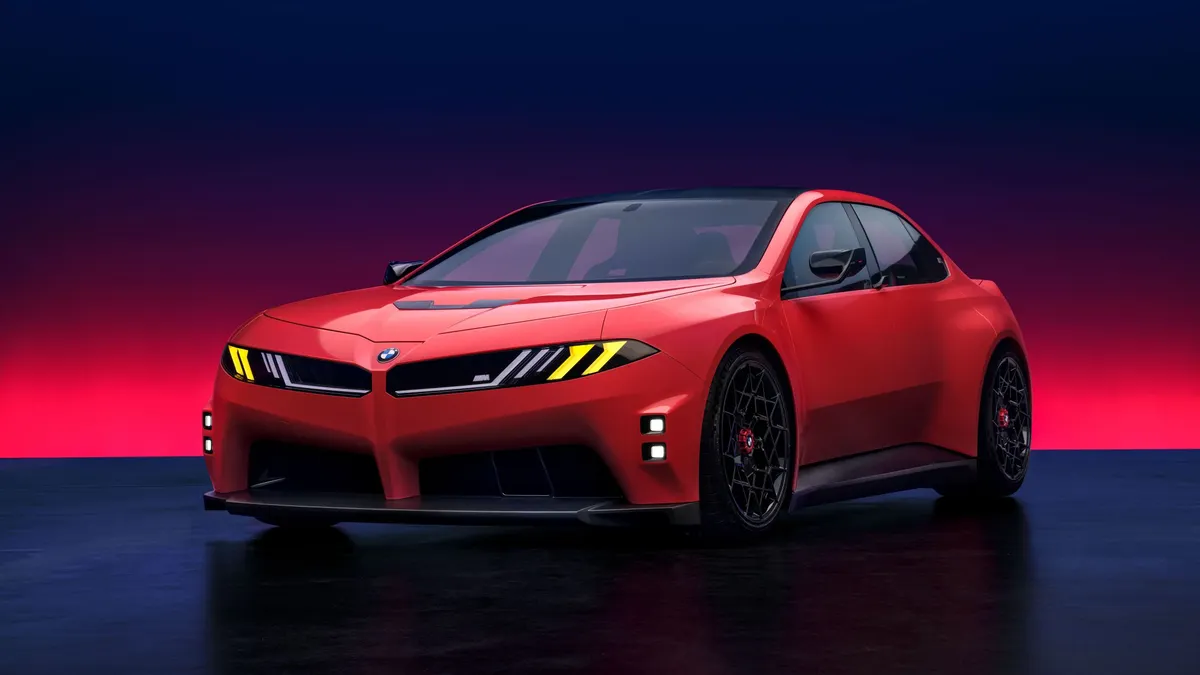
Just ahead of last weekend’s 24 Hours of Le Mans, BMW's M performance car division unveiled the M Concept Neue Klasse, providing the clearest indication yet of the design and technology direction for a fully electric BMW M3 sedan due to enter production in 2027.
The concept previews how BMW M intends to adapt the automaker’s Neue Klasse architecture, first introduced on the second-generation iX3, for future performance models. Along with showcasing a new design language for BMW’s M subsidiary, the concept provides an early look at the drivetrain, control systems and software technologies planned for the production electric M3, which is scheduled to arrive in 2027.
The M3 EV, with actual production badging not yet confirmed, will be sold alongside a new combustion-powered successor, giving buyers two distinct interpretations of BMW's best-known performance sedan.
Its unveiling at Le Mans is no coincidence. BMW says the concept draws heavily on lessons learned from motorsports, with influences from both GT racing and the BMW M Hybrid V8 endurance racer currently competing in the FIA World Endurance Championship and IMSA SportsCar Championship. The company describes it as a bridge between its racing activities and a new generation of high-performance road cars.
"The BMW M Concept Neue Klasse gives a first glimpse of how BMW M transfers the DNA of our high-performance automobiles into the Neue Klasse era," said Frank van Meel, chief executive officer of BMW M GmbH.
The concept also builds on the BMW i3 sedan revealed in March, which previewed one of the first passenger-car applications of the Neue Klasse architecture. The i3 is intended to serve as the electric counterpart to BMW's 3-series sedan, the model that has defined the brand for generations.
Although clearly related to the i3, the M Concept Neue Klasse adopts a more aggressive look. The body sits lower and wider, with flared wheel arches housing wide tracks and larger wheels and tires, larger air intakes and a more pronounced aerodynamic package than its standard sibling. BMW has sought to retain the clean surfacing and simplified forms of the Neue Klasse design language while giving the concept the visual presence expected of a modern M car.
Classic M3 proportions, just electric
Viewed in profile, the concept retains the classic sports-sedan proportions that have long defined the M3, including a long wheelbase, short overhangs and a rearward-set cabin. The wider tracks and muscular wheel arches give it a noticeably more purposeful stance than the standard i3, while large aerodynamic wheels are designed to reduce drag and improve cooling.
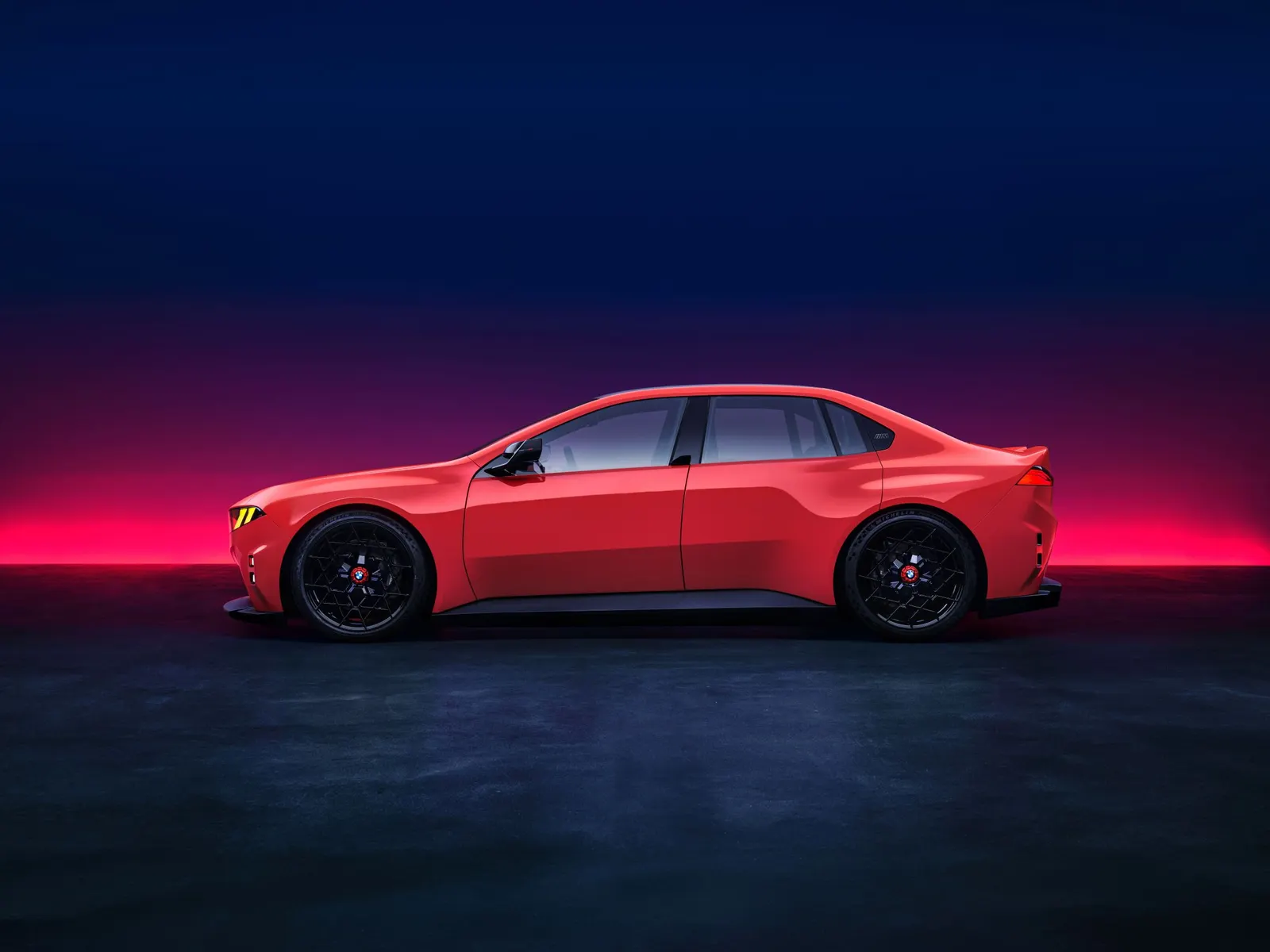
The concept also previews BMW M's increasing use of lightweight materials. Natural-fiber composite components replace carbon-fiber elements in several areas, including the front splitter, diffuser and hood vent.
Inside, the cabin adopts a minimalist, driver-focused layout around four newly developed bucket seats and M-specific digital displays. Black nubuck trim combines with blue and red accents, while the displays and controls reflect the wider Neue Klasse interior philosophy.
A Heart of Joy and four motors
The most significant developments, however, lie beneath the bodywork.
BMW hasn’t yet revealed power, torque, acceleration or range figures for the production model. Instead, the company is placing greater emphasis on the underlying vehicle architecture and control systems that it believes will define the driving experience of future M cars.
The electric M3 is being developed around a four-motor layout with one motor assigned to each wheel. BMW says the arrangement allows torque and braking forces to be controlled independently at each corner of the vehicle, providing a level of precision not possible with traditional mechanical differentials or conventional all-wheel-drive systems.
Central to the system is a new vehicle dynamics control architecture known as BMW M Dynamic Performance Control. Working alongside BMW's latest high-performance control unit, called Heart of Joy, it manages propulsion, braking, energy recuperation and stability functions through a single integrated software system.
BMW says the new control architecture processes information significantly faster than existing vehicle dynamics systems, allowing more precise management of wheel slip, traction and cornering behaviour. The company believes this will enable the electric M3 to combine the immediacy of electric propulsion with the handling characteristics traditionally associated with M cars.
Staying true to its roots, the electric version of the M3 has also been engineered to retain a rear-wheel-drive character. BMW says the front axle can be completely decoupled under certain driving conditions, allowing the vehicle to operate as a rear-wheel-drive sedan despite its four-motor, four-wheel drive drivetrain.
The electric M3 will also adopt the 800-volt Neue Klasse electrical architecture, with different cylindrical cells and engineered for repeated high-performance driving. BMW says the battery pack forms a structural component of the vehicle, contributing to body stiffness while supporting higher charging rates and increased energy recuperation capability versus the company's current generation of electric vehicles.
BMW also sees the concept as evidence that the transition to electric propulsion will not fundamentally alter the character of its performance models.
"Even in the new all-electric era, we continue the M-typical tradition of transferring both technological innovations and defining design features directly from motorsport into series production," said van Meel.