Editor’s note: John McElroy is the president of BlueSky Productions, which produces Autoline Daily, and a longtime opinion columnist for WardsAuto. Views expressed here are his own.
Things are getting ugly in the German auto industry, and they’re only going to get worse. Though it will likely survive the onslaught, it will emerge as a smaller industry, with a smaller workforce and a smaller manufacturing footprint.
This is sort of easy to predict because we’ve seen it all before in the U.S. auto industry, back when GM and Chrysler filed for bankruptcy in 2009. In a sentiment widely attributed to Mark Twain, history doesn’t repeat itself, but it often rhymes.
Here’s the situation: Europe’s auto market is flat. It’s not growing. In China, German automakers, like other foreign car companies, are watching their sales and market share plummet. U.S. tariffs have added billions of dollars in costs. And stringent EU emissions regulations, including an ICE ban in 2035, look almost impossible to achieve for legacy automakers.
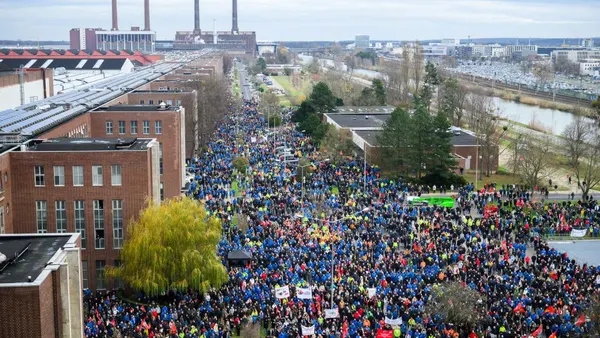
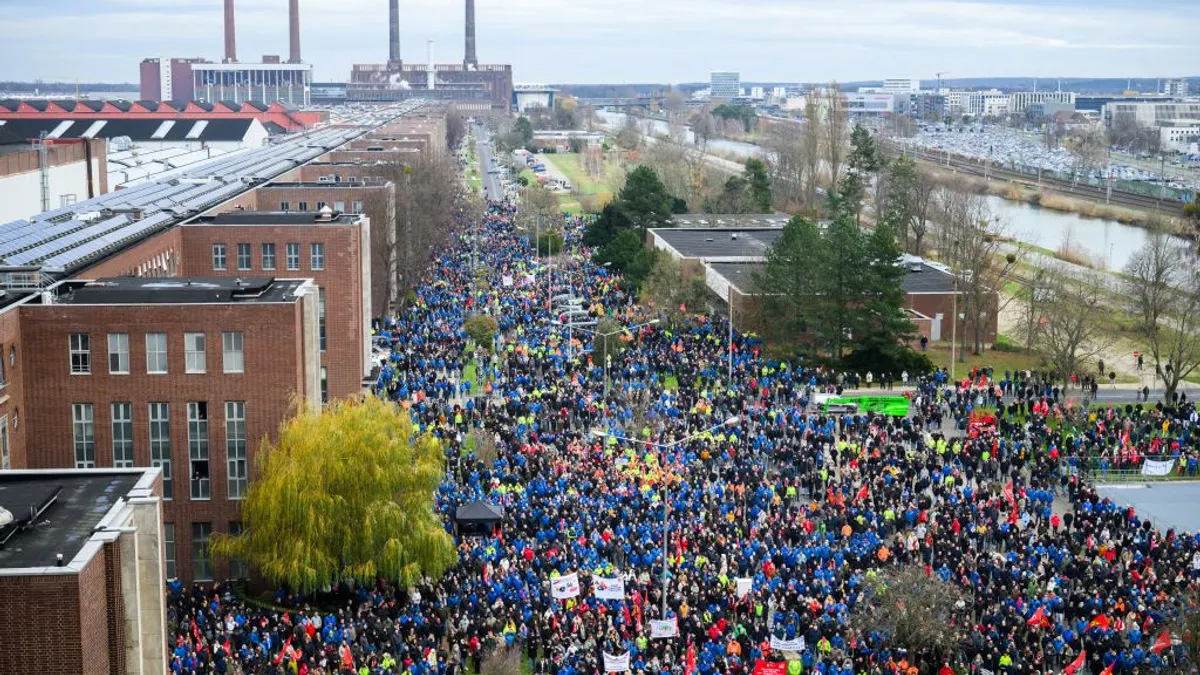
The Volkswagen Group, the second-largest automaker in the world, is in serious trouble. Its latest financial report shows the company’s net profit margin has sunk to less than 2%. It wants to close four assembly plants in Germany by 2030 and get rid of 100,000 jobs, including 7,500 jobs at Audi and 9,000 at Porsche.
BMW is going to get rid of 8,000 jobs and while Mercedes-Benz doesn’t plan to resort to mass layoffs, it will cut its workforce through retirements and natural attrition. In other words, Mercedes isn’t going to do much hiring.
According to the Center for Automotive Research in Ann Arbor, Michigan, each automotive job supports up to eight other jobs in the economy. So when VW says it’s going to get rid of 100,000 jobs, we’re looking at the German economy actually losing 800,000. It’s the ripple effect. When an auto plant closes, suppliers close plants too. So do the suppliers to the suppliers. And then all the truck drivers, cleaning crews, cafeteria workers, security personnel and everyone else down the line suddenly find themselves without a job.
What the German industry needs is radical restructuring and a helping hand from the government. But no one likes change, and the bitter medicine that’s needed to steady the situation is simply too much for most people to swallow…for now.
But you watch. Things will get worse. And when they get bad enough, people will start to accept what they now find unacceptable.
It’s stunning to see how quickly things changed. Only five years ago the German auto industry was riding high, with strong sales, fat profit margins and brands that commanded premium prices. Today, sales are slipping, profits are plummeting, and that German brand cachet is not quite what it used to be, notably in China.
I recently returned from a trip to Germany where I talked to a number of auto execs. They’re deeply worried, even dejected. They know the industry needs to make radical changes, but they don’t believe anything will happen until it’s too late. And by too late they mean bankruptcies.
A good example is at the Volkswagen Group, where over half the board of supervisors includes local politicians and labor leaders. They’re on the board to do one thing: protect German jobs. And they know that if they ever agree to massive job cuts, they’ll be thrown out on their ears and vilified for life. That’s why they’ve already announced that VW’s proposed plant closings and layoffs are completely unacceptable.
There’s talk of saving jobs by inviting Chinese automakers to use the plants slated for closure. But the Chinese are not going to locate in high-cost Germany. They’re already going to low-cost Eastern Europe and Spain. Besides, even if a move like that saves factory jobs it does nothing to save the jobs of the engineers, designers and all the other disciplines it takes to run a car company.
Volkswagen’s proposed solution is to add tariffs on Chinese PHEVs. But we’ve already seen that tariffs on Chinese BEVs haven’t stopped them from gaining market share. It won’t stop their PHEVs, either.
I believe what Germany needs now is a voluntary restraint agreement that freezes Chinese sales where they are. It’s not a great solution. But it buys time. And the alternative is factories that close to never reopen, jobs that are lost forever, and an economic malaise that stifles automotive communities across the country for many years to come.