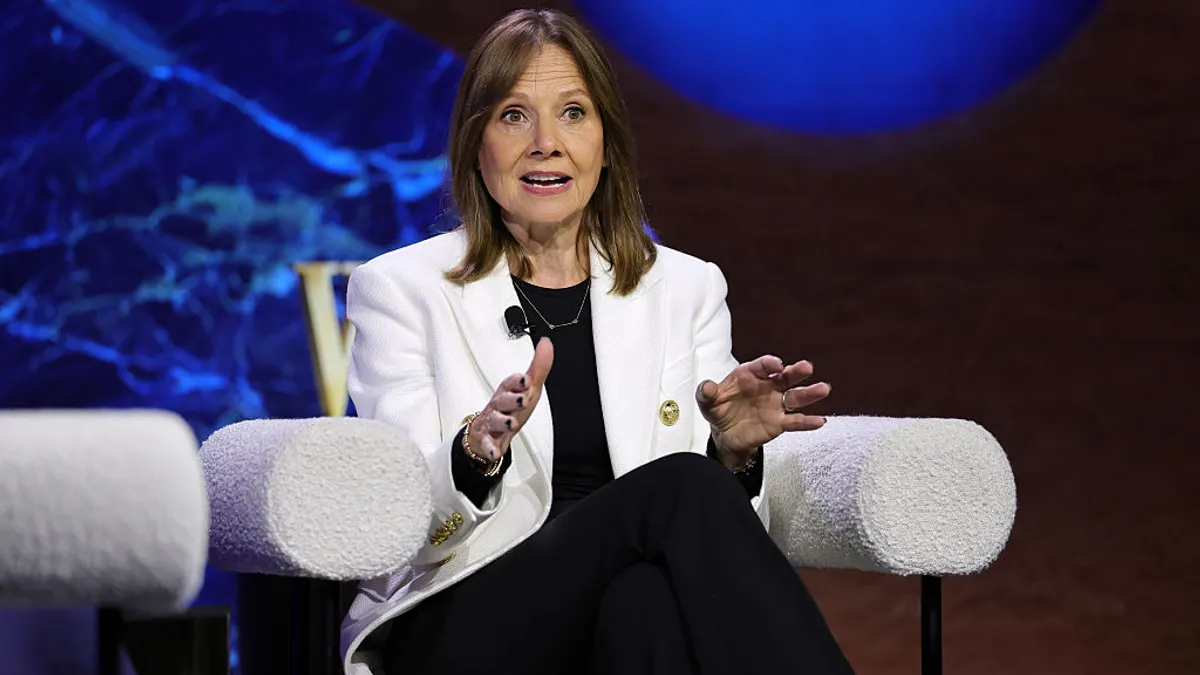
DETROIT — General Motors will continue its major focus on electric vehicles but at a slower pace than originally planned while also maintaining a strong position in ICE power in addition to some upcoming hybrids and plug-in hybrids, the company’s CEO Mary Barra said.
In a “fireside chat” before an Automotive Press Association audience ahead of the 2026 Detroit Auto Show, Barra discussed a number of issues, most notably GM’s revised product strategy in reaction to the Trump administration’s rollback of future fuel economy regulations and elimination of the $7,500 EV tax credit.
“We were headed to be 50% EVs from a regulatory perspective by 2030. But with the changes that are not completely done yet from a regulatory perspective, we are on a different path,” Barra said during the event at General Motors’ new World Headquarters in downtown Detroit.
“I think the great thing at General Motors [is that] we have a really strong EV portfolio that we're still committed to [and] we have a very strong internal-combustion-engine portfolio,” she said. “I've always said I didn't want the regulatory environment to drive EV adoption. I wanted it to be because people choose them because they feel they are better vehicles and fit their lives.”
EVs and ICE vehicles can coexist and thrive under the GM tent, Barra said, adding the automaker is investing in both “because we realized internal combustion vehicles even at 50% [of the product mix] are still very significant.”
“We have a leadership position in full-size trucks. We have a leadership position in full-size SUVs,” Barra said, noting took 50 years to establish that leadership position. “Frankly, what we want to do is translate that into leadership position in the EVs as well.”
Barra believes consumers will make rational decisions to choose EVs over time because they will be superior products.
“Once we have a robust charging infrastructure, I think people are naturally going to pick EVs because instant torque opens up new design language and never having to go to the gas station,” she said. “It will take longer without incentives, but I still think we will get there over time. We don’t know what the demand will be, but we are working hard and we're investing in new battery technology with LMR [lithium manganese-rich] to dramatically take the cost down.”
Barra added that she is surprised that some other OEMs have pulled back from EV development as quickly and as much as they have.
GM’s investments in technology go beyond electrification, the CEO said. The automaker will soon be putting its own “AI Assistant” into its vehicles and is already using AI in its processes “to help identify and improve the quality of our vehicles as well as speed and efficiency.”
However, the automaker has also pulled back on some investments in order to focus its efforts. Barra offered GM’s experience with its robotaxi arm Cruise as an example, saying the company “made the decision to not be in the rideshare business.”
“As we deploy our capital, we want to focus on personal vehicles and personal autonomy, not running rideshare leads,” she added. “We don't run a taxi business. We don't run a bus business. We're not running Rideshare 1.0. So, I think it's the right decision for us.”
Barra also acknowledged consumer concerns about affordability, saying: “Last year we sold over 700,000 vehicles that started under $30,000 MSRP. So, I think we're really addressing that and have affordable vehicles.”